
The padel mental game: stop losing points you already won
Lost a match to a pair you're better than? The padel mental game isn't confidence, it's error management, and it happens in the 20 seconds between points.
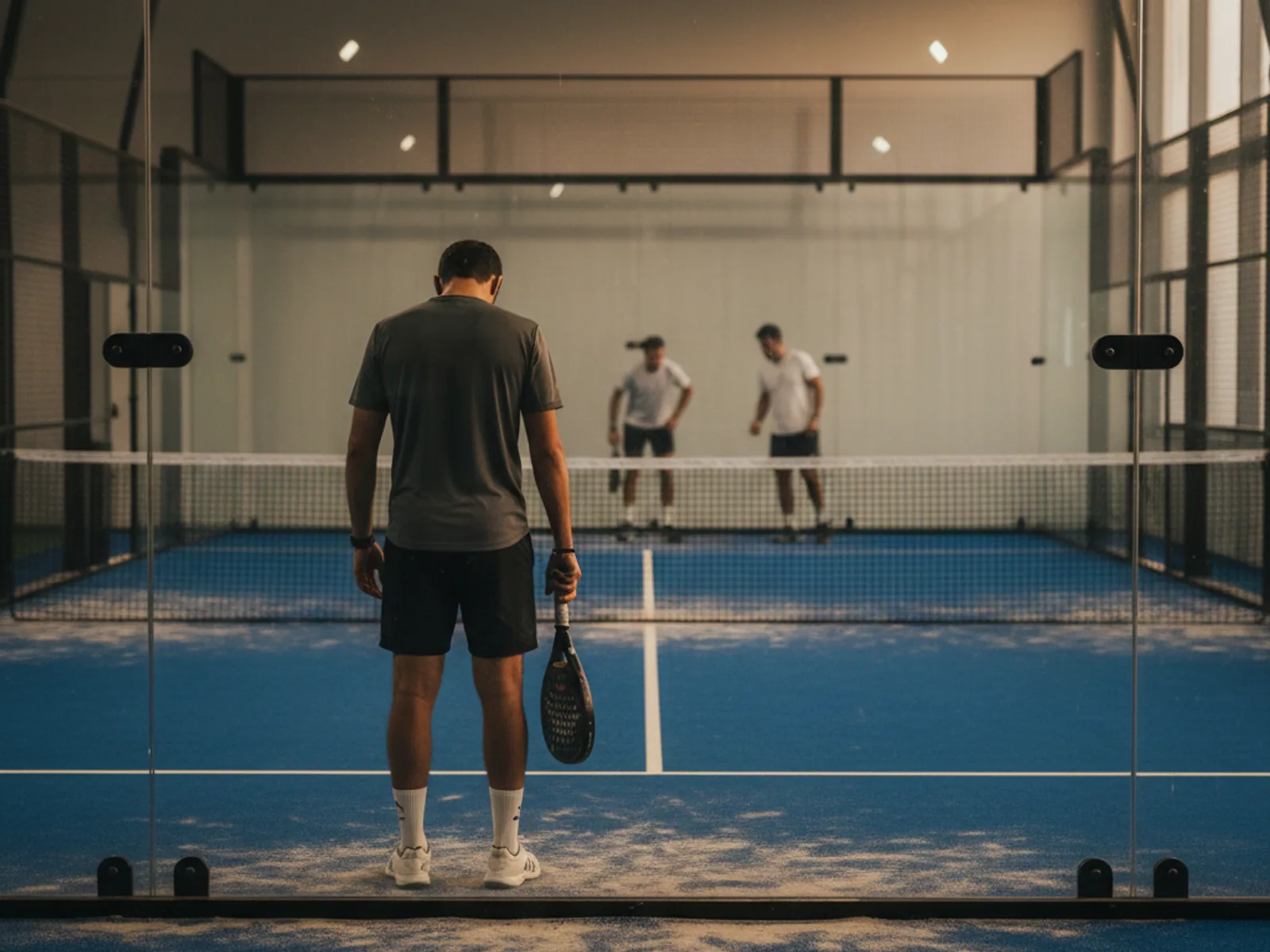
You lost to a pair you were better than, and you can still recite the score. Nobody out-hit you. You handed them a run of points in the second set, and by the time your head cleared the match was gone. We’ve lost that one more than once.
That’s a mental game problem, and it’s fixable without a new stroke. Not by believing in yourself harder. By changing what you do in the few seconds after a point ends, the one stretch of a match where nobody is hitting a ball at you.
TL;DR
The padel mental game is error management, not motivation. More padel points end in a mistake than in a winner, so the players who reset fastest between points should win matches their strokes say they shouldn’t. You get 20 seconds. Build a routine that fits inside it.
- Reset on a routine, not a feeling. Turn, breathe, one word, one decision, feet set.
- Change one thing, not five. Give it two points before you judge it.
- Say it out loud. Your partner is reading you either way, so give them words, not body language.
- Keep score of errors, not moods. Three lines after the match beats a diary you’ll abandon.
Why the padel mental game is an error problem, not a confidence problem
Count how your points actually finish. More end with somebody missing than with somebody hitting a ball nobody could reach. That holds at every level of padel anyone has studied, and amateurs sit further toward the error end than professionals. A lot of the gap between you and a better player is mistakes they don’t make.
If points were won, your head would be there to make you braver. Points are mostly lost, so your head’s job is to make you donate less.
The walls are why this belongs to padel. The ball comes back, it stays alive off the glass, and a rally runs long enough for you to have opinions during it. That extra beat is where the error comes from.
Geography backs it up. In the pro game, where the counting has been done, points get finished at the net and errors mostly happen at the back. The stretch of the rally where you give most away is also the one where you have the most time to think, which lines up with what padel court positioning already tells you.
Nobody has tested whether resetting faster actually wins padel matches, so what follows is a read rather than a result. If most points are given away rather than taken, the pair that clears the last one quickest gives away fewest of them.
Stop treating a bad patch as a confidence dip. Treat it as an error count, because that’s a number you can move on Tuesday.
The 20 seconds you actually get between points
The rulebook gives you a maximum of 20 seconds between points: the whole window in which you get to be annoyed, work out what went wrong, and decide what happens next. Changing ends buys 90, more than four times the room, and the end of a set buys 120, enough to fix the plan and not just your breathing. After the first game of a set, and all the way through a tie-break, you get nothing. You swap ends and keep playing, which is exactly when a rattled player most wants a minute.
Club play is untimed, and nobody at your club is holding a stopwatch. The window is real anyway, because the next point is coming whether you’re ready or not.
Here’s a routine that fits inside 20 seconds.
- Turn away from the net. Two steps toward the back glass, away from whoever won the point.
- One breath, longer out than in. You’re resetting your hands, not meditating.
- One word for what happened. “Late.” “Rushed.” “Fine.” One word, because two become an argument with yourself.
- One decision for the next point. Where the ball is going, not how you feel. “Cross.” “Lob first.”
- Face front and set your feet before the server does. Still walking when they toss means you’ve lost the start.
Do that this week. One session, that routine, every point, won or lost. Skip the ones you won and it becomes a punishment you’ll quit.
The tell: you lost the point before it started
The obvious signs arrive late. Racket down, a word to yourself, the shrug.
The quieter ones show up first, and they start with your return, where the ball you’d normally hit turns into a roll-back. Then your feet stop resetting. You hit, you watch, you admire, and the split step is the first thing to go.
You start hitting middle, not because it’s the right ball, but because it’s the shot with the least blame in it. And you go quiet. No calls, no “yours,” because your attention is still on the last point.
All four are the same switch: from playing to win the point to playing to not miss it.
Safe is frequently correct, though. Middle is a good target against a pair with a weaker backhand-side player, and slowing a rally down is a tactic, not a symptom. The tell is the pattern, never the single shot. A run of safe returns, with quiet feet and a quiet mouth, is a slide.
Your padel mental game has a partner in it
Your mental state isn’t private. It’s standing three feet away, in full view, the whole match. Your partner reads it whether you broadcast or not, and so do the two across the net, who’ll aim at whoever has gone. Advice built for solo sports has nowhere to put any of that, which is why so much of it reads hollow on a padel court.
So your reset is a shared object and it needs words. After your partner misses:
- Short. “Next one.” “Good idea.” Four words is the ceiling.
- Forward-facing. About the ball that’s coming, not the one that left.
- Tactical out loud, technical never. “Let’s lob the next two” is a plan. “You’re dropping your shoulder” is a lesson, and mid-match it lands as blame however kindly you meant it.
Then the part players tell us about constantly and act on almost never: some partners make your mental game worse, and no routine fixes it. If every match with the same person ends with both of you tight and clipped, that’s information. Who you play with is a choice, and the effort you spend to find padel partners pays back more than another hour of drilling.
How to get out of a padel losing streak mid-match
You’re a few points into a slide. The instinct is to change everything: swing harder, move up sooner, try the shot you’ve hit well twice in your life. Three experiments at once, and you can read none of them.
Change one thing. Give it two points, not two games. The order runs cheapest to most expensive.
- Target first. Deeper, higher, more middle. Costs no technique, and it fixes a lot of bad patches on its own.
- Tempo second. Slow it down. Lob more, make them play more balls, take the pace out of a rally you’re losing at speed.
- Pattern last. Change who you’re hitting at and which side. Biggest change, so it goes last.
Two points tells you whether contact is cleaner, not whether you’re winning, so don’t judge on the scoreboard that fast.
Padel scoring rewards the discipline. Golden point is normal in club and league play, so one ball at three-all can settle a game, and a run of close games turns fast in both directions. Intermediate padel tips carries the shot-by-shot version of these choices. One change, two points, then decide.
What the padel mental-game research actually shows, and what it doesn’t
Most of what gets written about mental toughness in padel is feelings with a lab coat on. The honest version is thinner than you’d hope.
The research on padel players is small and mostly measures nerves. Players at a higher level report more self-confidence and less physical anxiety than players below them. Players who lost report more anxiety than players who won, measured after the match as well as before.
Here’s what it doesn’t show: that calming down makes you better. The studies line two things up and find they travel together, without establishing which is pulling. Winning is calming, and being good is calming, and both explain the data as well as “calm players win” does. Anyone selling confidence as the input is going further than the evidence goes.
Use the level language for what it’s worth: padel levels is a straighter mirror than how nervous you felt on Saturday. Stop treating confidence as the input. The errors are the part you can put your hands on.
Keep a padel match journal, three lines and no feelings
Three lines, written in the car before you drive off, not at home once the story has set:
- What was working. One shot or one pattern.
- What I kept missing. The repeat, not the worst one.
- One thing to try next time.
Don’t grade your mood, focus or attitude out of ten. That version feels serious and dies fast.
The point is the pattern. One match is noise: you played badly, or the wind, or your partner had a night. A few entries in, the same word keeps turning up, and that’s what you take to a lesson.
How to train your padel mental game this week
- Run one session where the routine is the only goal. Turn, breathe, word, decision, feet. Count the points you ran it on, not the score.
- Test it against real opponents. Book a court in our directory of padel courts near you and take the routine into a game that counts.
- Write the three lines after the match. In the car, before you talk yourself into a version of events.
- Take one habit a week. Subscribe to the Sunday Drop for one fixable thing plus a US court worth knowing.
You don’t need to feel better to play better. You need to miss less.
FAQ
How do I stay calm during a padel match?
Give yourself something to do instead of something to feel. A fixed sequence between points, turn away, one breath, one word, one decision, feet set before the serve, beats telling yourself to relax, because it fits in the 20 seconds you actually get. Run it after points you win too, or it becomes a punishment and you’ll stop using it.
Why do I play worse in matches than in practice?
Because the swing changes without you deciding anything. A practice ball costs you nothing, so you finish the stroke; a match ball costs you something, so the stroke comes out shorter, later and more tentative. The first sign is safe shots showing up before bad ones do.
How do I stop getting frustrated with my padel partner?
Say less, and say it forward. “Next one” and “let’s lob the next two” is close to the whole vocabulary, because technical corrections mid-match read as blame no matter how kindly you mean them. If the frustration runs both ways every time you play together, that’s a pairing problem rather than a discipline problem.
Does the mental game matter more in padel than in other racket sports?
We can’t rank sports honestly, and anybody who does is guessing. What is specific to padel is that the walls keep the ball alive, so rallies run long enough for your head to get involved, and more points end in a mistake than in a winner. Treat your head as a source of errors to cut, not a mood to manage.