
The padel racket buyer's guide
Which padel racket to buy, by player tier and budget. Beginner picks, intermediate upgrades, advanced frames, and the ones to skip. No shilling.
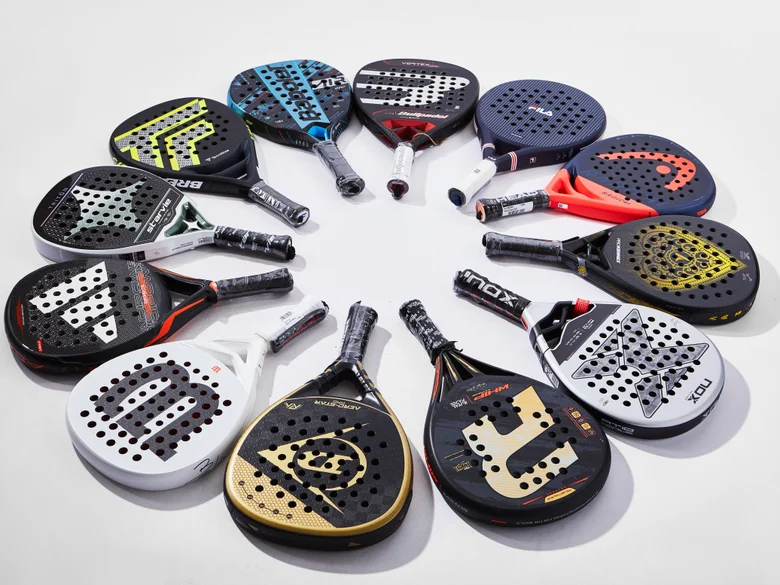
You can spend $40 on a racket that does the job for six months. You can spend $300 on one that does the job for two years. Spending more doesn’t always mean buying better. It usually means buying different.
This is the racket buyer’s guide we’d hand a friend on the phone. Tiered by player experience, with specific picks per tier, and an honest “skip these” list at the end.
Before you buy: four questions
Don’t go shopping until you can answer these four. They matter more than any spec sheet.
1. How long have you been playing?
This is the single most important variable. Padel rackets are aggressively tiered. A racket that fits an 18-month player will frustrate a 3-month player. A racket that fits a 3-month player will bore an 18-month player. The wrong-tier racket isn’t a bad racket. It’s just the wrong tool for you right now.
2. What’s your playing style developing into?
You don’t need to know your final padel identity. You just need a rough read. Are you the patient back-court player who runs every ball down? Or the aggressive net player who lives on bandejas and finishes? Or genuinely all-court at this stage?
If you don’t know, you’re an all-court player. That’s the default and the safest pick.
3. What’s your budget tolerance?
Be honest. Are you the person who buys once and uses it until it breaks? Or are you the person who upgrades every season because new gear is fun? Both are fine. Different choices follow.
4. Boost your strengths or minimize your weaknesses?
This is the framework most padel coaches use when picking a racket for someone. Two valid approaches:
Boost your strengths. If you’re a patient back-court player who runs every ball down, a control-tuned round racket leans further into what you already do well. If you’re an aggressive net player, a diamond-shaped power racket amplifies your game.
Minimize your weaknesses. If your defense is shaky, pick a racket with more power and stiffness so you can survive more rallies. If you mishit too often, pick a more forgiving sweet spot even if it costs you some power.
The pros use this same framework. Bullpadel famously gave a defensive specialist on their tour roster the most powerful racket in their lineup, specifically to minimize his defensive gaps. Coello goes the opposite direction: he’s already an attacker, and his racket amplifies that strength even further. Tapia sits in the middle, on a heavy racket with intermediate balance and high maneuverability so he can add spin to anything.
Neither approach is wrong. Just know which one you’re picking.
When to buy (the timing trick)
The padel racket market is cyclical. Major brands launch their new flagship lines in the last months of the year. Two value windows follow:
Black Friday. Last year’s models get aggressive discounts as retailers clear inventory. Save up to 20 percent on rackets that play almost identically to this year’s “new” version.
Early in the new year (January and February). Same logic. The cycle resets, last-year models discount further, and this-year models hit retail at full price.
The trick is to go vintage and buy last year’s model. The iPhone-16-out-so-you-buy-the-15 strategy.
The evidence that this works: most year-over-year racket “updates” are cosmetic, not structural. The Bullpadel Hack AT10 (Tapia’s flagship racket and the consistent bestseller) only changed roughness and bat cap between the 2024 and 2025 models. The Siux Vertex’s only difference between years was that the vibration dampeners came pre-installed instead of sold separately. The “new” version isn’t materially different. The price difference is.
Pay the new price only if you can identify a real spec change that actually matters to your game.
Tier 1: Your first padel racket (under $80)
The honest answer for almost every beginner: you don’t need to optimize. You need a racket that doesn’t actively hurt your learning. Most clubs rent rackets in this tier and they’re fine for the first few weeks.
If you’re going to buy one for yourself:
Look for:
- Round head shape (more forgiving sweet spot)
- 360 to 370 gram weight (medium, not heavy)
- Soft EVA foam core (forgives off-center hits)
- Brand-name (avoid the $20 Amazon no-name)
Specific picks in this tier:
- Head Zephyr UL. Light, round, beginner-coded. Around $60 to $80.
- Babolat Air Veron. Light frame in the Air series, easy entry. Around $75.
- Bullpadel Indra. Bullpadel’s entry-level option. Around $70.
Avoid in this tier:
- No-name carbon-fiber rackets on Amazon (almost universally inconsistent)
- Anything labeled “professional” at this price (probably mislabeled)
- Vintage rackets from 2020 or earlier (foam degrades, technology moved on)
Tier 2: First real upgrade (3 to 6 months in, $80 to $150)
This is where most padel players make their first real purchase decision. You’ve played a while. You know the difference between a forehand drive and a bandeja. You’re ready for a racket that responds to what you’re trying to do.
Look for:
- Round or teardrop head shape (still want forgiveness)
- 365 to 375 gram weight
- A small amount of carbon fiber in the face (helps with control)
- A grip-shape that fits your hand (try it physically if possible)
Specific picks in this tier:
- Adidas Match 3.3. Round, balanced, beginner-to-intermediate transition racket. Often discounted to around $120. Genuinely good first upgrade.
- Babolat Counter Viper. Teardrop, slightly more aggressive, holds up as you progress. Around $130 to $150.
- Bullpadel Vertex 04 Comfort. A small step up from the entry Bullpadel line, comfortable for longer sessions. Around $140.
- Head Delta Hybrid. Round-to-teardrop transition shape, decent control. Around $130.
Be honest with yourself: if you’re still hitting off-center 4 out of 10 shots, drop back to Tier 1. The Tier 2 rackets reward better technique. They punish worse technique.
Tier 3: Intermediate (6 to 18 months in, $150 to $220)
This is the largest and most contested tier. Your game has identity by now. You know whether you live at the back or at the net. You probably have a favorite bandeja angle. You’re ready for a racket that pushes your game forward instead of just keeping up.
Look for:
- Frame shape that matches your style (round = control, diamond = power, teardrop = both)
- 365 to 380 gram weight
- More carbon fiber in the face (now you can feel the difference)
- Established model that’s been on the market 1 to 2 years (early-cycle rackets sometimes have hidden quality issues)
Specific picks in this tier, by style:
For the patient back-court player (control-first):
- Bullpadel Vertex 04 Control. Round shape, control-tuned. Around $200.
- StarVie Aquila Soft. Round, soft face, defensive-coded. Around $180.
For the aggressive net player (power-first):
- Adidas Metalbone Light. Diamond shape, lighter version of the pro Metalbone. Around $210.
- Nox AT10 18K. Diamond, popular among aspiring smashers. Around $220.
For the all-court player (balanced):
- Head Alpha Pro. Teardrop, balanced, holds up across styles. Around $200.
- Adidas Drive 3.3. Teardrop, balanced, generous sweet spot. Around $180.
This tier is also where most players try to skip ahead. They see the Adidas Metalbone 2026 at the lower end of Tier 4 (around $230) and reach for it. Don’t, unless you’re confident in your net game. The Metalbone hits like a brick wall in the words of the players who own it. That’s exactly its strength and its risk.
Tier 4: Advanced and power player ($220+)
This is the tier where rackets get specialized, expensive, and unforgiving. We don’t recommend Tier 4 rackets to anyone under 18 months of consistent play, regardless of athletic background.
Look for:
- Diamond or teardrop-diamond hybrid shape
- 375 to 385 gram weight (heavier, more momentum)
- High-carbon construction throughout
- A model that pro tour players actually use (the pro endorsement isn’t marketing; the rackets are built different)
Specific picks in this tier:
Power-first (the racket pros use to crush):
- Adidas Metalbone 2026. The flagship. Diamond, heavy, brutal. Around $250.
- Bullpadel Hack 03. The other flagship-tier power racket. Diamond, hard-hitting. Around $260.
- Nox AT10 Genius. Slightly more forgiving than the AT10 18K. Around $240.
Control-first (for advanced defenders):
- StarVie Basalto Soft Pro. Round, advanced control. Around $230.
- Babolat Technical Veron. Round-to-teardrop, balanced, advanced control. Around $250.
Note on the Bullpadel Hack Comfort: the Hack Comfort gets recommended a lot online as “the comfortable version” of the Hack. Skip it if you’re under six months in. It’s still a Hack. The “comfort” is marketing, not a meaningful tier reduction.
Pro racket ≠ store racket. This is the single most underrated point in any buyer’s guide. The retail Adidas Metalbone 2026 you can buy at any padel shop is meaningfully different from the racket Galán actually plays with at Premier Padel events. Pros modify their rackets: firmer foam in the face, reinforced frames, custom grip wraps, custom weight distribution. The retail version is the base spec. The pro version is the base spec plus a workshop’s worth of tuning.
What this means for you: use pro endorsements as a starting point for category (this is the kind of racket Galán plays with), not as a guarantee of identical feel. Even with the exact retail Metalbone in your hand, you won’t play like Galán. You’ll play like you, with a racket tuned for someone like Galán to push further.
The “skip these” list
Some rackets and categories that come up often but don’t earn their price.
1. Custom-painted “limited edition” frames. Often the same frame as the standard model, with a markup of $50 to $100. The paint job doesn’t change how it plays.
2. Rackets from athletes turned brands. Almost every pro tour player has a brand they put their name on. Some are real product. Many are reskinned OEM frames at a premium. If you can’t find the racket on the pro tour player’s actual hand, the brand is mostly licensing.
3. Anything more than two model generations old. Padel rackets degrade. The EVA foam in the face loses responsiveness after about 18 months of regular play. A 2022 racket in 2026 is a 4-year-old frame. Skip it even if the price looks good.
4. Hyper-power Tier 4 rackets for under-12-month players. The Adidas Metalbone 2026 and Bullpadel Hack are great rackets. They make players in their first year worse, not better. Wait for your game to demand more before you spend on Tier 4.
5. “Tennis-crossover” marketing. Some rackets get marketed to former tennis players (“just like a tennis racket but for padel”). They are not just like tennis rackets. Buy on the padel-specific criteria above, not on tennis-style heritage.
Frame shape, in slightly more depth
A two-minute primer because the questions never stop.
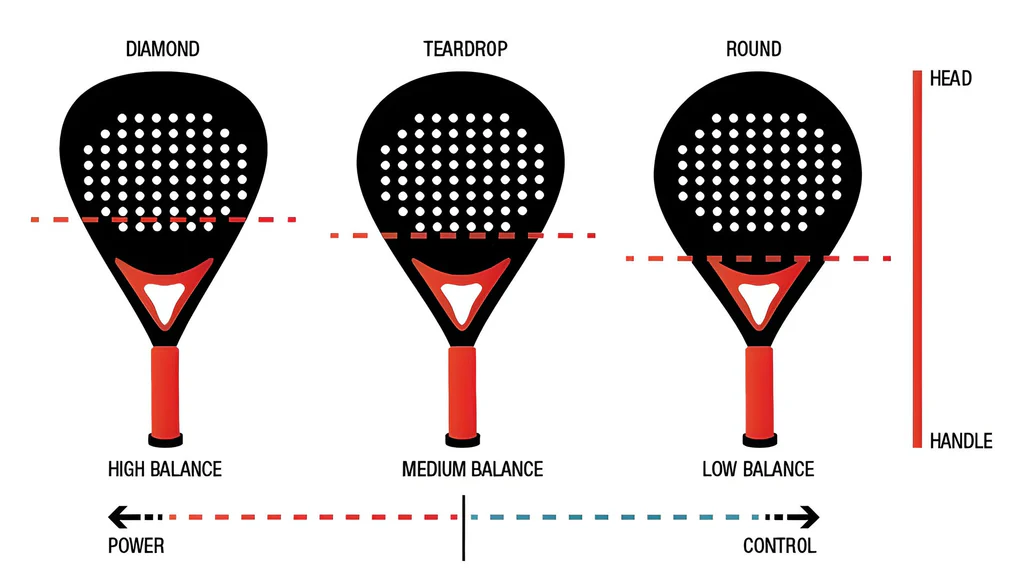
The red line marks each frame’s balance point: high toward the head on a diamond, mid on a teardrop, low toward the handle on a round. The higher the balance, the more power and the less control. That trade-off is the whole reason shape matters.
Round head. Sweet spot is centered. Most forgiving. Defensive-coded. Easier for beginners and back-court players who build points slowly and trust their precision over their power. Usually paired with a low balance (weight closer to the handle) for maneuverability.
Diamond head. Sweet spot is high. Most powerful. Aggressive-coded. Demands clean contact. Punishes mishits hard. Best for confident net players who finish points instead of constructing them. Usually paired with a high balance (weight toward the head) so the racket head feels heavier through contact.
Teardrop head. Sweet spot is mid-high. The compromise. Versatile across styles. The default if you don’t know which way you lean. Usually paired with a medium balance.
The shape-style-balance map:
| Shape | Style | Balance | Best for |
|---|---|---|---|
| Diamond | Attacking | High | Net-finishers and smashers |
| Teardrop | All-court | Medium | Players developing both attack and defense |
| Round | Defensive | Low | Patient back-court players, beginners, anyone with elbow or shoulder sensitivity |
Some brands break these conventions (a diamond with low balance, a teardrop with high balance). When that happens, the brand is usually trying to give players the look of a category with the playability of another. Read the balance number more than the shape label.
You don’t need to overthink shape. Buy the tier first. Pick the shape that matches your style second.
A note on hardness
Padel racket hardness is roughly equivalent to string tension in tennis: an underrated spec that changes everything about feel. The harder the racket, the less the frame flexes on contact, and the more energy transfers directly to the ball.
Higher hardness gives you:
- More control (the racket does less of its own thing)
- More power on clean strikes (energy transfers efficiently)
- Less natural ball output (the racket isn’t doing the work for you)
The trade-off: harder rackets are less forgiving. Mishits feel worse. Vibration increases. Your elbow and shoulder absorb more shock per shot.
Brands rarely advertise hardness as a single spec. Look at the foam (EVA Soft, EVA Medium, EVA Hard, or specific brand-named foam tiers) and the face material. More layers of carbon mean a harder racket. Fiberglass surfaces are softer and more comfortable. If you’re choosing between two rackets and one is described as “comfort” or “soft” while the other is described as “pro” or “tour,” the second is harder.
If you have any history of tennis elbow or shoulder issues, lean softer. Always.
Climate matters more than you think
The same racket can feel completely different in Miami versus Boston in February. This is the spec almost nobody talks about and it changes how a racket plays in your hand.
- Hot temperatures and humidity make balls heavier and rackets softer. You lose some control and need to swing harder for the same result.
- Cold temperatures make rackets stiffer and balls livelier. Your normal swing produces more pace.
- Higher altitude (Denver, Phoenix, mountain clubs) makes balls livelier and shots easier to put away.
Practical implications:
- If you play year-round in a hot, humid climate (Miami, Houston, most of the Southeast), lean toward a firmer racket to compensate for the natural softening.
- If you play year-round in a cold climate (Boston, Chicago, Denver winters), lean toward a softer racket to offset the natural stiffness.
- If you live somewhere with big seasonal swings (NYC, DC, Salt Lake City), the honest answer is to eventually own two similar rackets. One firmer for summer, one softer for winter. Brands like Adidas already cater to this by releasing some flagship models in both “normal” and “hard” versions, and Nox uses aluminized carbon constructions specifically to resist temperature swings.
This is a refinement, not a starting point. Don’t go shopping for a “Miami racket.” Buy the tier and shape that fit your game, then nudge harder or softer based on climate.
When to upgrade
Three honest signals it’s time:
1. Your current racket isn’t keeping up with shots you can now hit. You’re consistently producing bandejas with topspin and they’re dying short because the racket can’t generate the velocity. Time to upgrade.
2. The frame is more than 18 months old and you play 2+ times per week. The EVA foam is degrading whether you can feel it or not. Replacement is normal maintenance.
3. You stopped feeling improvement from practice for three consecutive months. Sometimes the racket is the bottleneck. More often the player is. Be honest about which it is before you spend.
Don’t upgrade because:
- A new model came out. The 2026 version of any racket is rarely a real upgrade over the 2025. The Bullpadel Hack AT10 only changed roughness and bat cap between 2024 and 2025. The Siux Vertex’s only year-over-year change was that vibration dampeners came pre-installed instead of sold separately. Cosmetic differences, not feel differences.
- A pro player just signed with a brand (they got paid to use it, and they’re playing a modified version of the retail racket anyway).
- Your friend got a new racket (their game is not your game).
What to do next
Three things, in order:
1. Be honest about your tier. Months played, not self-perception. A 3-month player who plays five times a week is a different buyer than a 12-month player who plays once a month.
2. Try before you buy if you can. Many US clubs (especially Padel Haus locations and bigger venues) have demo programs. A 30-minute hit with a candidate racket beats every spec sheet on the internet.
3. Match the shape to your game, not to whoever endorses it. Round frames forgive and control, teardrop suits players still developing both wings, and diamond rewards those who can already finish points cleanly. Buy the shape that fits how you play now, not the one you hope to grow into.
Don’t spend more than you need to. Don’t spend less than you actually need to. Most padel mistakes are made trying to skip the tier above where you actually are.
Useful sources
If you want to go deeper than this guide goes, these are the two video resources we’d point you at next. Watch them when you’re ready to think harder about your next racket purchase.
The first breaks down the seven keys to choosing the right padel racket in 2025:
The second walks through how to choose the right padel racket from the ground up: