
Adidas padel rackets: the 2026 range, explained
Adidas' 2026 padel range is three families: Metalbone, Cross It and the new Arrow Hit. What each is for, what the suffixes mean, and what they cost in the US.
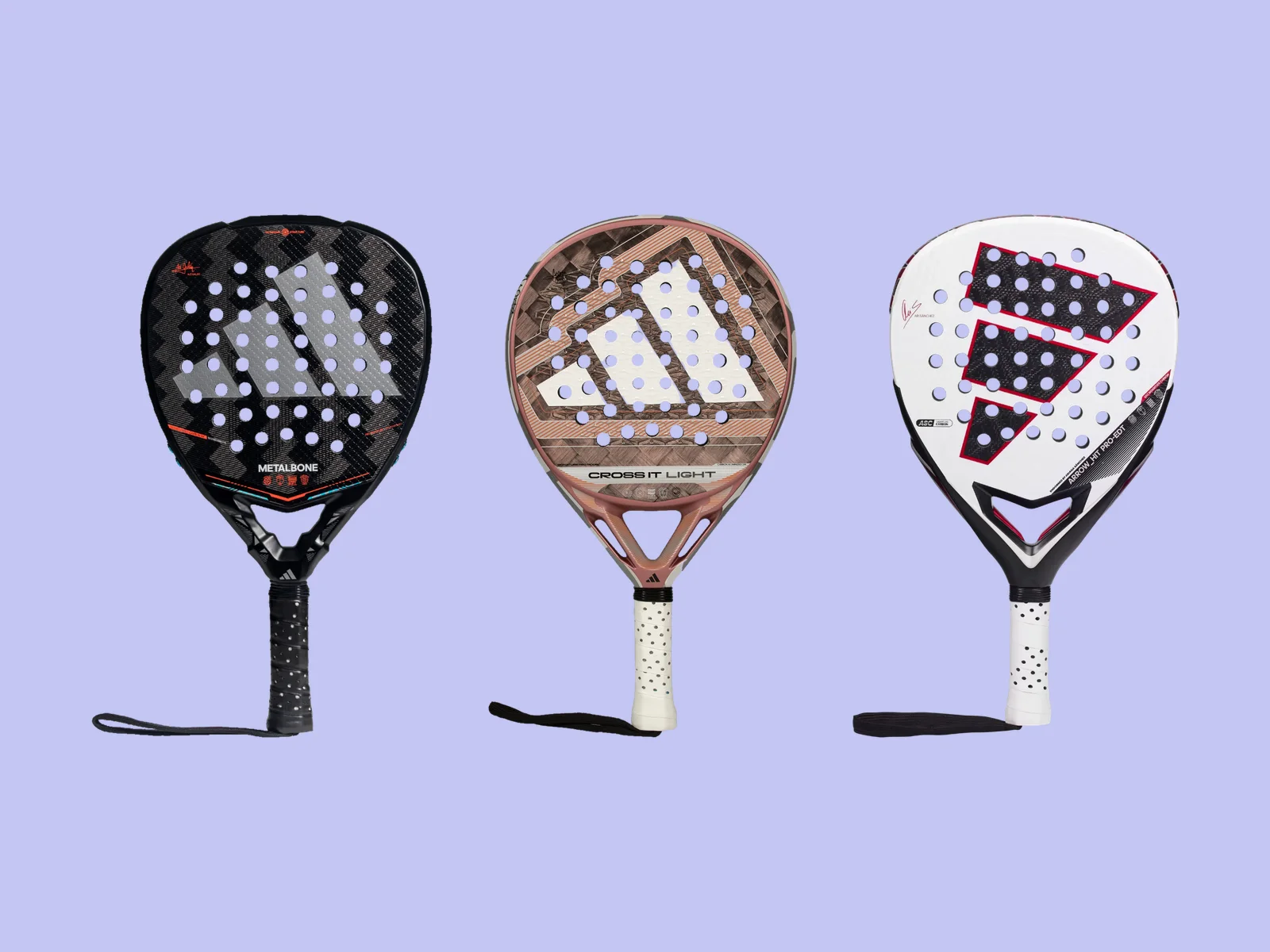
Ever wondered why there are so many different Adidas padel rackets, and which one is actually right for you? Search for one and the results read like a catalog with no logic in it. Metalbone HRD+ 2026. Cross It Carbon Ctrl. Arrow Hit Hexagon Cup. A shelf of 3.4s underneath, at prices that don’t line up with anything.
It’s three rackets and a naming system. Adidas has been shipping padel collections since 2014, and several of those generations are still selling side by side, which is where the sprawl comes from. By the end of this guide you’ll be able to tell which rackets suit you, or even your buddies. Once the core elements make sense, the model suffixes, the shapes, the materials, and the way each racket is built, you can place most of the Adidas rackets you’ll see, in any shop, at any price, without opening a spec sheet.
TL;DR
The 2026 Adidas padel range is three families and one naming system. Pick the family by what you want the racket to do, then let the model suffix set the trim and the price.
- Metalbone. Power, and finishing points at the net. Ale Galán’s family. Around $455 at the top, around $235 for the Team Light.
- Cross It. Aerodynamics, fast preparation, control. Marta Ortega’s family, and the cheapest way into the current range at around $210.
- Arrow Hit. New for 2026. Precision and control. Ari Sánchez’s family, and the priciest at around $518 for the Pro Edition.
- Then read the model suffix. Ctrl, HRD, Carbon, Light, Superlight, Team, Reserve, Pro Edition. Eight words that cover most of what you’ll see, and the number on the end is the year.
Everything else you’ll meet online, RX Series, Discovery, Drive and Match among them, sits outside that collection. It’s still Adidas. It just isn’t this.
How Adidas got into padel
Adidas signed its first padel player in 2013: Marta “Martita” Ortega, an unknown young player at the time. She’s still on the roster in 2026 with her own signature Cross It, which is a long time to stay with one brand in this sport. The first racket collection shipped in 2014.
Then the run that built the name. Adidas took the World Padel Tour’s official racket slot over from StarVie in 2017 and held it through 2018. Ale Galán signed in February 2018 and won his first professional tournament about two months later, in Valladolid, on an Adipower, the line Adidas launched in 2016 and left out of the 2026 collection. Galán is still on the roster, now on a Metalbone.
The US chapter starts in 2024, when Adidas became the official court supplier of the Pro Padel League. A year later it became official racket of the A1 Padel world circuit.
Here’s why that history is on your screen and not in a museum. Adidas ships a new collection every year and the old ones don’t leave. So when the same racket name sits in front of you at two very different prices, what separates them is the generation: a different face, and on the Metalbone a different frame. The job the family does hasn’t changed.
What Adidas is trying to put in a racket
Strip the trademark names off and one idea keeps coming back: a racket you can change after you’ve bought it.
Both top families let you do this: the Metalbone 2026 carries a Weight & Balance System and the Arrow Hit an IBS, an Intelligent Balance System, interchangeable weights that let you move where the mass sits. You may well set it once, like it, and never touch it again. But if you’ve ever walked off court thinking the racket felt a shade too head-heavy, this is the brand that lets you do something about it without reaching for lead tape.
The second theme is air, and it lives in the holes. Cross It is built around Dynamic Air Flow: the holes through the middle of the face are there to cut air resistance and make the racket easier to move. The Cross It Light goes further with something called 11 Thirteen, which is as literal as a trademark gets. Eleven of the central holes are drilled narrower than the other thirteen.
The faces are where the marketing gets loudest. Carbon Aluminized 16K on the 2026 Metalbone, Carbon Aluminized 24K on the Cross It Light. The K counts the carbon weave, and a bigger number is a different weave, not automatically a better racket. Read it the way you’d read a megapixel count on a phone.
Spin Blade is the surface texture, and it isn’t one thing. Metalbone gets Spin Blade Decal, Cross It gets Spin Blade Mold: two ways of putting a 3D pattern on the hitting face for grip on the ball. That one you can check with your thumb in a shop, which is more than most racket technology can say for itself.
The 2026 Metalbone frame is Low Poly, faceted rather than smooth. Read it as a power feature rather than a handling one, because that’s where the spec sheets file it.
Then one nobody markets and everybody touches: Extra Power Grip, on both Metalbone and Cross It. The handle runs longer, which Adidas says adds inertia and power.
One we’d file under graphics rather than engineering: ASC, Adidas Signature Carbon, on the Arrow Hit. It’s carbon woven in the pattern of the Adidas logo. It looks good. That’s the job.
Then core hardness, which is the one on this list that will actually change your session. And the first thing to know is that Metalbone doesn’t mean firm. The standard Metalbone 2026 runs a low-density soft core; only the HRD+ carries High Memory EVA, the firm one. In the other family, Cross It Light and Team Light use Soft Energy EVA, softer again.
As a rule of thumb, firm rewards a fast, clean swing and punishes a late one, while soft forgives more and gives up some ceiling. Where you land on that depends on your swing, not your budget, and how to choose a padel racket walks the shape-and-weight half of the same decision.
If you only take one thing from a technology list, take the core. The carbon weave number won’t change your Tuesday.
The 2026 Adidas lineup: three families
Here is the whole collection in one view. Every 2026 Adidas racket belongs to one of these three.
| Family | What it’s built to do | Who fronts it |
|---|---|---|
| Metalbone | Power, and finishing points at the net | Ale Galán |
| Cross It | Aerodynamics, fast preparation, control | Marta Ortega |
| Arrow Hit | Precision and control. New for 2026 | Ari Sánchez |
Pick the family first. The suffix is the easier half and it comes second.
Metalbone
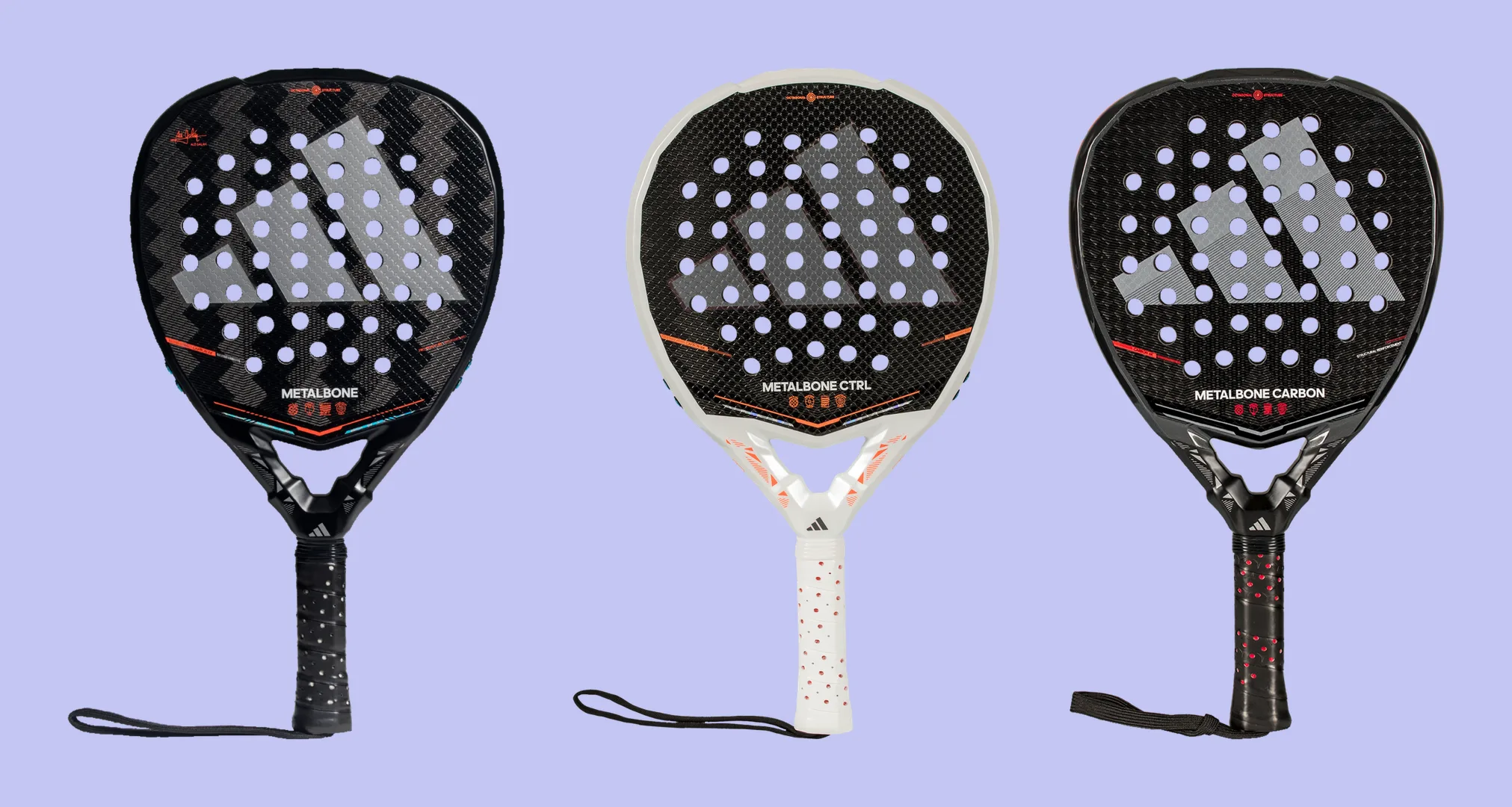
The power line. Ale Galán’s name is on the 2026 version, and the family is built around one job: getting to the net and ending the point from there.
| Rung | What changes |
|---|---|
| Metalbone 2026 | The flagship. The reference point for everything under it |
| Metalbone HRD+ 2026 | Same family, the firm High Memory EVA core |
| Metalbone Ctrl 2026 | The flagship tuned away from raw power |
| Metalbone Carbon 2026 (and Carbon Ctrl) | The step down from the flagship |
| Metalbone Team / Team Light 2026 | The entry rungs |
| Metalbone Reserve and Pro Edition 2026 | Special runs. Pro Edition is Galán’s own paint job |
Prices move, so treat these as a snapshot rather than a price list. In the US the Metalbone 2026 sits around $455, and so do the Ctrl and the HRD+. The Carbon comes in around $305, the biggest single step on that ladder once you set the special runs aside, and the Team Light lands around $235.
That spread is worth sitting with, because the top of this family and the bottom of it are not the same purchase. And before you assume the flagship is the hard one: it isn’t. The plain Metalbone 2026 is the soft-core version. The firm one costs the same and has a plus sign on it.
Cross It
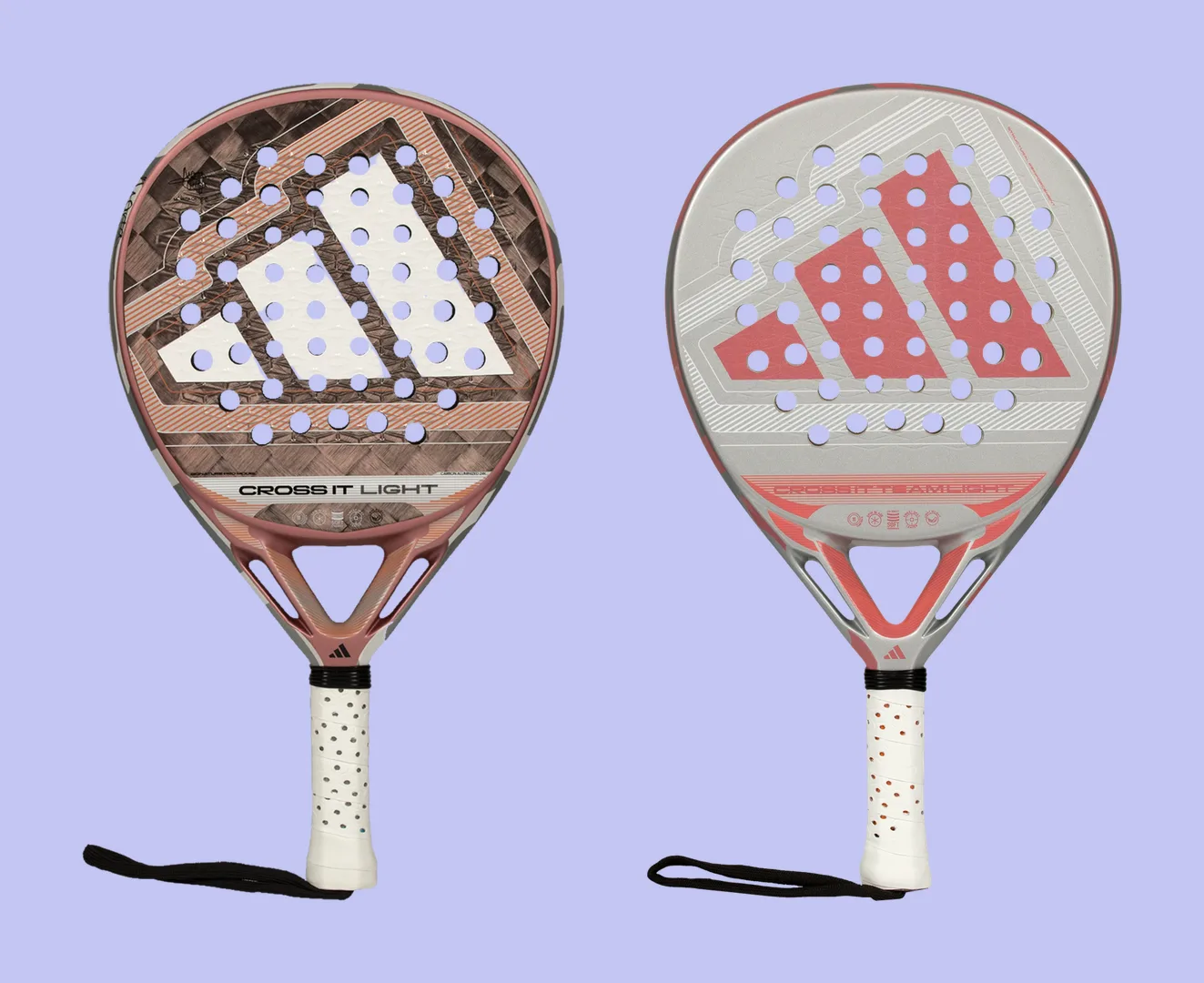
Where Metalbone is about the finish, Cross It is about arriving first. The whole family is shaped for swing speed: air moving through the middle of the face, a frame meant to slice through rather than shove aside. It’s aimed at one specific moment, the ball coming back faster than your preparation.
Marta Ortega, the brand’s first padel signing, still fronts it with a signature Light.
| Rung | What changes |
|---|---|
| Cross It Ctrl 2026 | The control-biased frame |
| Cross It Light 2026 | Lighter, with a softer core. Ortega’s version |
| Cross It Carbon 2026 / Carbon Ctrl 2026 | The step down |
| Cross It Team Light / Team Ctrl 2026 | The entry rungs |
| Cross It Pro Edition 2026 | Ortega’s paint job, built on the Light |
US pricing, again as a snapshot: the Light turns up on US shelves listed as Cross It Light 3.4 2026, at around $350. The Team Light is around $210, the lowest sticker we’ve seen on any 2026 Adidas frame in the US.
If your problem is that fast hands beat you rather than that you can’t finish, start here.
Arrow Hit
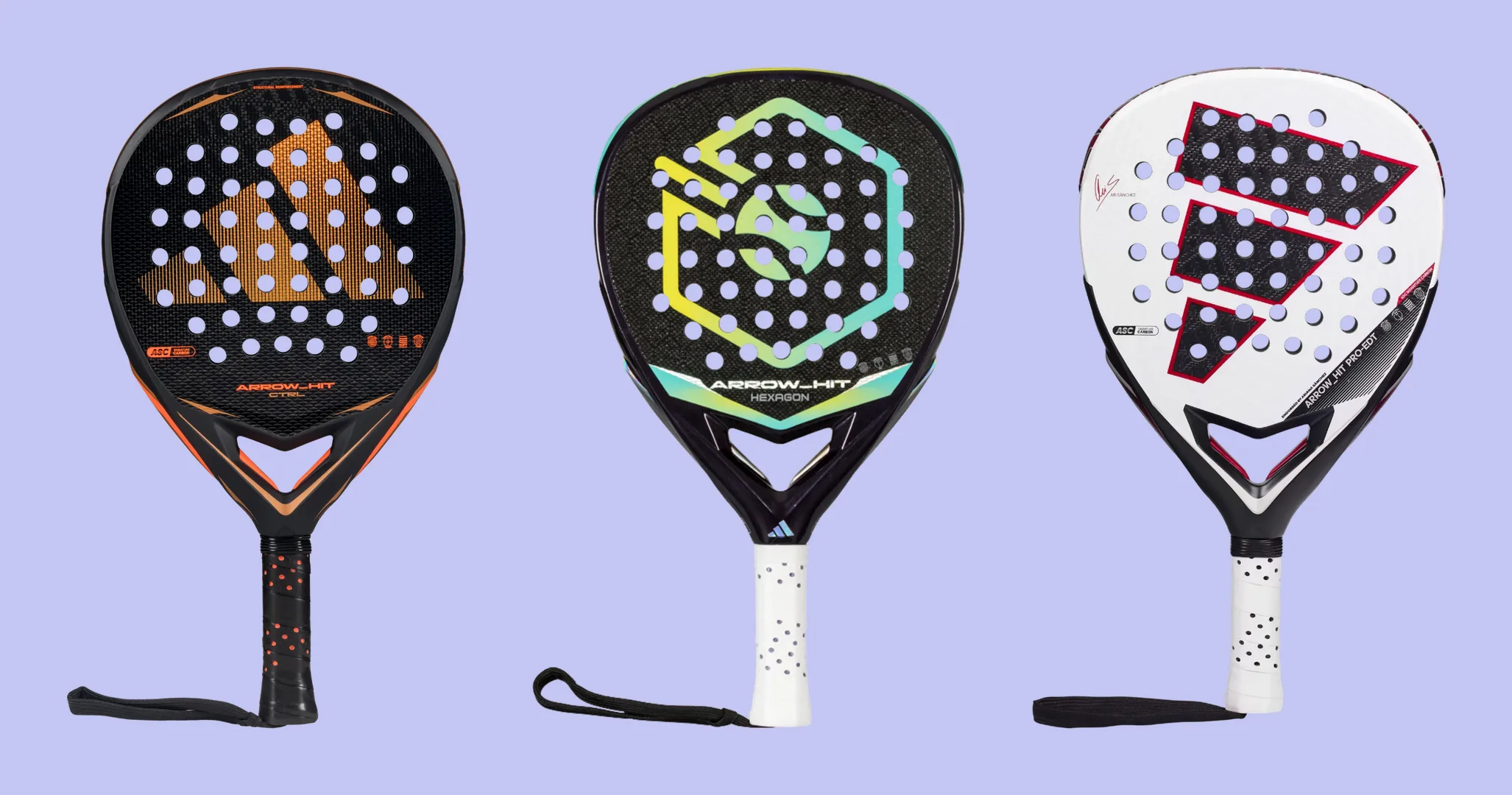
The new one, and the only new family in the 2026 collection. Arrow Hit is the precision-first family: its IBS takes the same interchangeable weights as the Metalbone, and the Signature Carbon weave gives you the logo. Ari Sánchez fronts it.
| Rung | What changes |
|---|---|
| Arrow Hit Ctrl 2026 | The control-biased frame, with the adjustable weights |
| Arrow Hit Light | Lighter build |
| Arrow Hit Carbon / Carbon Ctrl | The step down |
| Arrow Hit Hexagon Cup 2026 | The lowest US price in the family |
| Arrow Hit 2026 Pro Edition | Sánchez’s paint job, top of the range |
The Pro Edition runs around $518, the top of the Adidas range in the US. The Ctrl is around $465. The Hexagon Cup comes in around $310.
Which also means there’s nothing to wait for and nothing to hunt down cheap. Arrow Hit has no back catalog. You buy it at 2026 prices or you buy something else.
How to read an Adidas racket name
Every Adidas racket name is built the same way: family, then model suffix, then generation. Eight words carry most of the suffixes.
| Model suffix | What it tells you |
|---|---|
| Ctrl | Control, and a round shape. The same frame with a bigger, more forgiving sweet spot |
| HRD / HRD+ | Hard. The firm High Memory EVA core, which on Metalbone means the HRD+ |
| Carbon | The rung below the flagship. On Metalbone that’s the drop from around $455 to around $305 |
| Light | Lighter, and usually paired with a softer core |
| Superlight | Lighter still. We’ve only seen it in the Metalbone family |
| Team | The entry rung, and where a family’s price gets reasonable |
| Reserve | A name we’ve only seen on Metalbone, and the one word here that doesn’t tell you what the racket does |
| Pro Edition / Pro EDT | The player’s own paint job |
A working map, not a complete one. Tournament runs, junior frames and multiweight versions all carry words that aren’t on it. If a word on the label isn’t in the table, treat it as a special run until something tells you otherwise.
Shape hides in the name too, and shape tells you more about how a racket plays than any material does. A plain Metalbone or an HRD+ is a diamond: the weight sits high, the sweet spot sits high, and it hits hard from the top of the face. That’s the power setup, and it’s what Galán plays. Add Ctrl to the name, or drop to a Team Light, and the same family turns round, with a lower balance and a bigger, more forgiving sweet spot. Cross It is round across the whole range, which is part of why it suits fast hands over big finishing. So before you read a single spec, the family and the Ctrl tell you the shape, and the shape tells you the kind of game the racket wants to play.
The number at the end is the generation, and Adidas labels by year. Metalbone 2026 is the 2026 Metalbone, on Adidas’ own European store and on its US store alike. That’s the system to learn, and it’s the only one Adidas uses.
The wrinkle is what other shops do with it. Plenty of third-party retailers still bolt a decimal onto the name, almost certainly because the decimals are what buyers still search for. It maps onto the years:
3.2 = 2023 · 3.3 = 2024 · 3.4 = 2025 · 3.5 = 2026
So a listing that reads Metalbone 3.5 2026 isn’t a special edition and isn’t two rackets. It’s the 2026 Metalbone with a shop’s old tag stapled to the front of it. Here’s the tell: check the product URL. On those listings it usually ends in something like adidas-metalbone-2026, because the shop’s own system knows what it’s selling even when the title doesn’t.
Same story with the Cross It Light 3.4 2026 sitting on a US shelf. It reads like a contradiction and it’s just two labelling habits colliding in one product title. When the two disagree, believe the year.
Now put it together. Metalbone Carbon Ctrl 2026: power family, one rung below the flagship, tuned toward control, current year. You know roughly what it costs, roughly what it’s for, and that there’s a plain Metalbone Ctrl 2026 sitting above it if you want the full version.
Two words and a number gets you most of the way. What’s left is paint and special runs.
The ranges outside the 2026 collection
Adidas puts its name on more padel rackets than the 2026 collection contains. Its own US store lists three more series alongside the three families: RX Series, Discovery and Beginner. All current, none of them part of the 2026 performance collection, and each its own separate range.
Two more names, Drive and Match, live in the European catalog. Both carry 2026-labelled models and neither appears at Adidas’ US store, so getting one into your hand is a shipping problem rather than a shopping decision.
None of that is a warning, it’s a filter, and it’s the fastest one here. If the racket in front of you isn’t a Metalbone, a Cross It or an Arrow Hit, it isn’t part of the 2026 performance range, whatever year is printed on the label. Beginner at least tells you what it’s for. The others you’d have to look up.
Is last year’s Adidas padel racket worth buying?
Adidas keeps several generations selling at once, so a US search for a Metalbone hands you a 2026 and a 2025 in the same row at two different prices. Bargain, or leftover?
Start with what’s actually new this year, because the list is short. The Metalbone got Carbon Aluminized 16K and the Low Poly geometry. The Cross It Light got Carbon Aluminized 24K. And the entire Arrow Hit family, IBS and Signature Carbon included, did not exist before 2026.
That gives you one clean answer straight away. If the racket you want is an Arrow Hit, there is no last year’s version to hunt for. Buy current, or buy a different family.
Metalbone and Cross It are messier. A 2025 frame, a 3.4 on the shops that still use decimals, is one generation back rather than obsolete, and it will be cheaper. What you give up is the 2026 face construction and, on Metalbone, the new frame geometry.
In the Metalbone family the prices cross. Last year’s flagship and this year’s Metalbone Carbon land within a few dollars of each other, so the real question stops being new versus old and becomes flagship versus step-down. Our read, and this is a read rather than a tested result, is that we’d take the older flagship. We run the same call across other brands in our best padel rackets 2026 shortlist.
The practical move is to open both in the same tab and let the gap decide. If the older one saves you real money, take the saving. If it doesn’t, take the current one and stop thinking about it.
How to buy an Adidas padel racket in the US
What actually reaches a US address is narrower than the catalog suggests: the three 2026 families, plus a shelf of 2025 frames still selling alongside them. The prices we’ve quoted are the ones we’ve seen listed here.
Where you get one, roughly in order of how much choice you’ll have:
- Specialist padel shops online. The widest selection by far, and where the full family ladders actually live. Padel USA is one we use, ships domestically, and gives readers a discount with PADELKIN8OFF. It isn’t the only one, so it’s worth a quick price check across a couple of stores before you commit. While you’re shopping, look at the rest of your padel gear too, because a new racket does nothing for shoes that have stopped gripping.
- Club and venue pro shops. Narrower stock, usually full retail, but you get to hold the thing, and the good ones keep a demo rack. If you’re stuck between two rackets, this beats any table on this page.
- Racquet and tennis shops. Hit or miss. Some are adding a padel wall and a small padel rack; plenty haven’t yet. Worth a call before a drive.
- Big-box sporting goods. Padel is new enough in the US that the performance families mostly aren’t on these shelves yet. Fine for a first cheap paddle, not where you’ll find a Metalbone.
- Second-hand. Facebook Marketplace, the r/padel boards, club noticeboards. The best route to last year’s frame at a real discount, though the 2026 line is too new to show up used in any numbers yet. Check the frame for cracks and a dead, soft feel before you hand over money.
Then three moves, whatever channel you use.
- Settle the family before you look at a single model. Power and net finishing, Metalbone. Speed of preparation, Cross It. Precision and control, Arrow Hit. Everything after that is a suffix and a price.
- Demo before you buy if you can get your hands on one. An hour on court with the frame tells you more than any table on this page, and it’s the only way to find out whether a firm core suits your swing or fights it.
- Read the label before you pay. Find the year first. If a decimal disagrees with it, check the product URL and go with the year. And slow down on any listing that shows a decimal and no year at all, because that’s where you can end up paying a current-year price for an older frame.
Family first, suffix second. The rest is paint.
FAQ
What’s the difference between Adidas Metalbone, Cross It and Arrow Hit?
They’re built for three different jobs: Metalbone is the power family, aimed at finishing points at the net. Cross It is the aerodynamic family, shaped to move through the air fast so your preparation isn’t the thing that’s late. Arrow Hit is new for 2026 and is the precision family, control-oriented and the newest of the three. Every other Adidas name you’ll see in the 2026 range is one of those three with a suffix attached.
Is “Adidas padel tennis” the same as Adidas padel?
Yes, same thing. “Padel tennis” is a phrase you’ll meet far more often online than at a club, and people use it to mean padel. Search it and you should land on the same three families: Metalbone, Cross It and Arrow Hit. If your results keep serving you tennis rackets instead, drop the word tennis and search padel on its own.
What do Ctrl, HRD, Carbon and Team mean on an Adidas racket?
Ctrl is control: the same frame tuned away from raw power. HRD is hard, the firm High Memory EVA core, which on Metalbone means the HRD+ rather than the standard model. Carbon marks the rung below the flagship, and on Metalbone that’s the difference between roughly $455 and roughly $305. Team is the entry rung, Light and Superlight do what they say, Pro Edition is the player’s own paint job, and the number on the end is the year.
Where can I buy Adidas padel rackets in the US?
Padel USA ships Adidas to US addresses and carries one of the widest selections we’ve found stateside, with the code PADELKIN8OFF at checkout for a reader discount. Your local club is worth a stop as well, both to buy and to demo, since a racket that reads perfectly in a table can feel wrong the second you hold it. Plenty of the Adidas catalog you’ll find online is European and won’t ship to a US address, so check that the model in your basket is one of the three 2026 families before you get attached to it. Prices move week to week, so treat any figure you read, including ours, as approximate.