
How to hold a padel racket, and keep hold of it
Hand creeping up the handle by the third game? The continental grip in four steps, plus the three tells that say you've drifted off it mid-match.
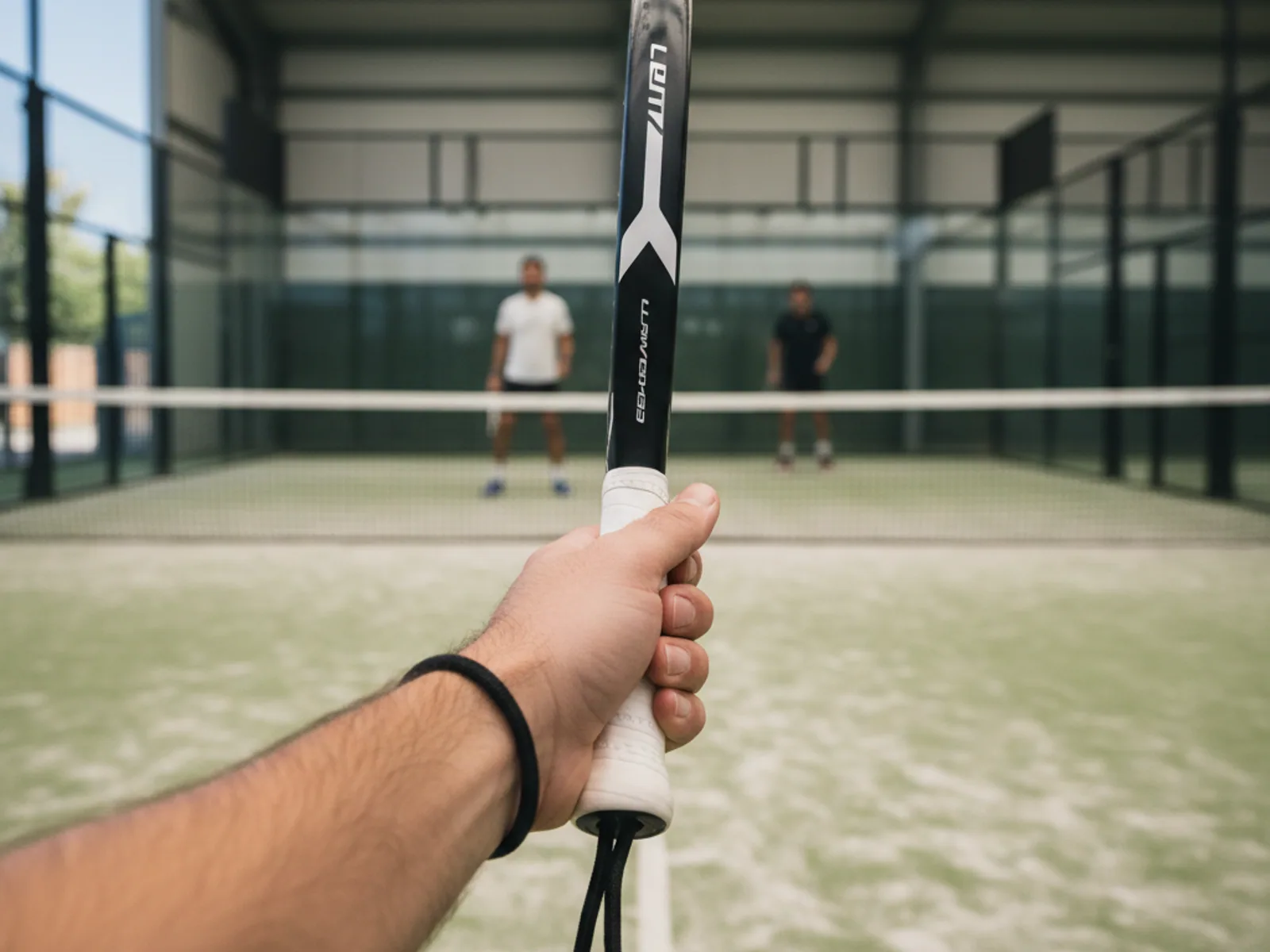
Most beginners hold the racket wrong. So do plenty of players a year in, still using the hand position they copied on day one and never questioned.
Worth knowing early, because the cost lands later. One of us played the best part of a year on a bad grip. Undoing it took weeks, a run of matches we used to win, and a lot of swearing at the back wall. Learning it properly the first time takes about ten seconds.
That’s the trap. Somebody shows you, you nod, you walk on. By the third game your hand has crept up the handle, your fingers have locked, and every ball off the back wall is finding the net.
Finding it is the easy half. Keeping it is the skill, and there are three diagnosable ways you lose it.
TL;DR
Padel asks you to learn one grip, the continental, then stop thinking about it.
- Hold it like a hammer. Frame edge-on, the V between thumb and index finger on the handle’s top edge.
- Hand low, index spread. At the base, not choked up, with a small trigger gap for the index finger.
- Fingers loose. Light through the swing, firm only at contact.
- Cord on, every time. The rulebook makes the wrist cord obligatory, not a courtesy.
The only grip padel really asks you to learn
If you’ve played a racket sport, you’re waiting for the list: one grip for the forehand, another for the backhand, another for the overhead. There isn’t one. Continental covers nearly everything: forehand, backhand, volley, bandeja (the controlled overhead that holds the net), smash.
The reason is time. The ball comes off the glass fast and rallies run long, so most points never hand you the beat you’d need to reshuffle your fingers.
One fewer decision mid-rally beats a marginally better forehand face.
How to find the continental grip
Do this now, without a ball.
- Hold the racket edge-on with your off hand. Frame pointing at the sky, like an axe blade ready to split wood.
- Find the V. The V between your thumb and index finger is your reference point, not your palm.
- Set the V on the top edge. Then slide your hand down to the base, near the butt cap.
- Wrap and check. It should feel like holding a hammer aimed at a nail in the wall in front of you, not one in the floor.
Or shake its hand. Same grip, different way in. Hold the racket edge-on and greet it the way you’d greet the player across the net. The V settles on the top edge on its own. Edge-on is the part that matters.
Easier to watch than read? The Padel School covers the same hand position here.
Where your hand sits on the handle
Now the first way you lose it. Under pressure, the hand creeps up the handle. It feels like control, and short term it is.
What it costs is reach. The ball dying low off the back glass is one you reach with the last inch of the handle, and choking up puts that inch in your palm.
Keep your hand at the base, butt cap against the heel of your palm. The governing body caps a padel handle at 20 cm, about the length of an adult hand from wrist crease to fingertip. There was never much to give away.
Spread the index finger slightly up the handle, like a trigger. If the handle is too slick to hold that lightly, that’s the band, not your hand, and a fresh best padel overgrip fixes it.
How hard to squeeze
Hold it like a bird. Tight enough that it can’t fly off, loose enough that you don’t hurt it.
Loose through the swing, firm only at contact. A dead squeeze locks the wrist and you pay twice: a ball off the glass comes back as a block you can’t aim, and your arm runs out of gas early.
Loose isn’t slack, your fingers still close at contact. Loose is just the correct side to be wrong on.
Three signs you’ve drifted off the grip
You won’t feel the grip move. You’ll see the results first.
Balls off the back wall keep finding the net. Your hand has rotated toward a forehand grip and closed the face. A low ball needs an open face to get up. Sneaky, because it reads as a lifting problem.
Your backhand volley keeps popping up. The opposite rotation. The face has opened too far, so the ball floats, lands short, and sits up at a height somebody will enjoy.
Your forearm is burning before the second set. You’re squeezing. Grip pressure climbs quietly as a match gets tight, and fatigue is the first honest report on it.
Check between points, never during them. Loosen, re-find the V, reset.
Why the tennis grip fails in padel
If you came from tennis, your forehand grip is the thing fighting you hardest. A semi-western or western grip closes the face and asks you to brush up the back of the ball. Perfect on a ball dropping at hip height.
Padel’s signature ball is the opposite: low and slow off the glass around your ankles, its pace spent. A closed face can’t lift it, so you bury it in the net or flick the wrist open to rescue it. That’s where the shanks come from.
It isn’t the only tennis instinct that misfires here, and padel for tennis players covers the rest. Fix this one first. It touches every ball.
When changing your grip is actually justified
Continental-for-everything is a simplification, and we’d rather say so than pretend anyone plays one flat hand position for three sets. What your hand wants shifts with the height of the ball, the pace on it, and how much time you have.
Some players shade toward an eastern backhand on the overheads, the bandeja and the víbora (the viper, its attacking cousin), and coaches disagree on whether that’s a real change or something that happens by itself. If your bandeja lands where you aimed, leave your hand alone.
The two-handed backhand is the other one, a choice rather than an error. Everything else stays continental. Let the exceptions find you.
Your wrist cord is part of how you hold the racket
One last piece, and the only part with an actual rule attached.
The FIP requires a non-elastic cord fixed into the handle and looped around your wrist, capped at roughly forearm length. The rulebook’s own words: “Its use is obligatory.” Not encouraged. Not recommended for beginners.
The reason is the room you’re in. Four people, a cage, and a racket that will leave a sweaty hand at some point. The cord decides whether it swings and stops, or travels.
Loop it before the first serve. It’s the one part of your grip that isn’t preference.
How to fix your padel grip this week
Three things, none needing a coach.
- Run the hammer test before you walk on. Edge-on in the off hand, V on the top edge, slide down, wrap.
- Play one set deliberately looser than feels right. Check your forearm afterward. That’s your calibration.
- Book a session and give it one job. Grab a partner, find a court near you, and spend a hit thinking about nothing but your hand.
Subscribe to the Sunday Drop if you want one fixable habit like these every week.
Your grip is the cheapest fix in padel: one thought, once, before the point starts.
FAQ
What grip should a beginner use in padel?
The continental grip, and only the continental grip. It covers nearly every shot and removes a decision you don’t have time to make. Learn it once, then spend your attention on your feet.
Is the padel grip the same as the tennis continental grip?
Same hand position, different job. In tennis it’s the serve and volley grip you drop for groundstrokes. In padel you find it and stay there, because the rally rarely hands you a window to change.
Should you change your grip for a backhand in padel?
Not for the standard backhand. With a two-handed backhand the off hand does part of the work, and that’s legitimate rather than a fault. Overhead shading tends to arrive on its own.
How tight should you hold a padel racket?
Loose enough that the handle can shift a little in your fingers, firm at contact. Grip pressure creeps up on its own once a match gets tight, and you won’t feel it happen. Forearm tired before the match is? Too tight.