
Where padel actually came from
Who invented padel, and where? The real padel origin story: a 1969 Acapulco backyard, an American playground game, and a 24-year trip home.
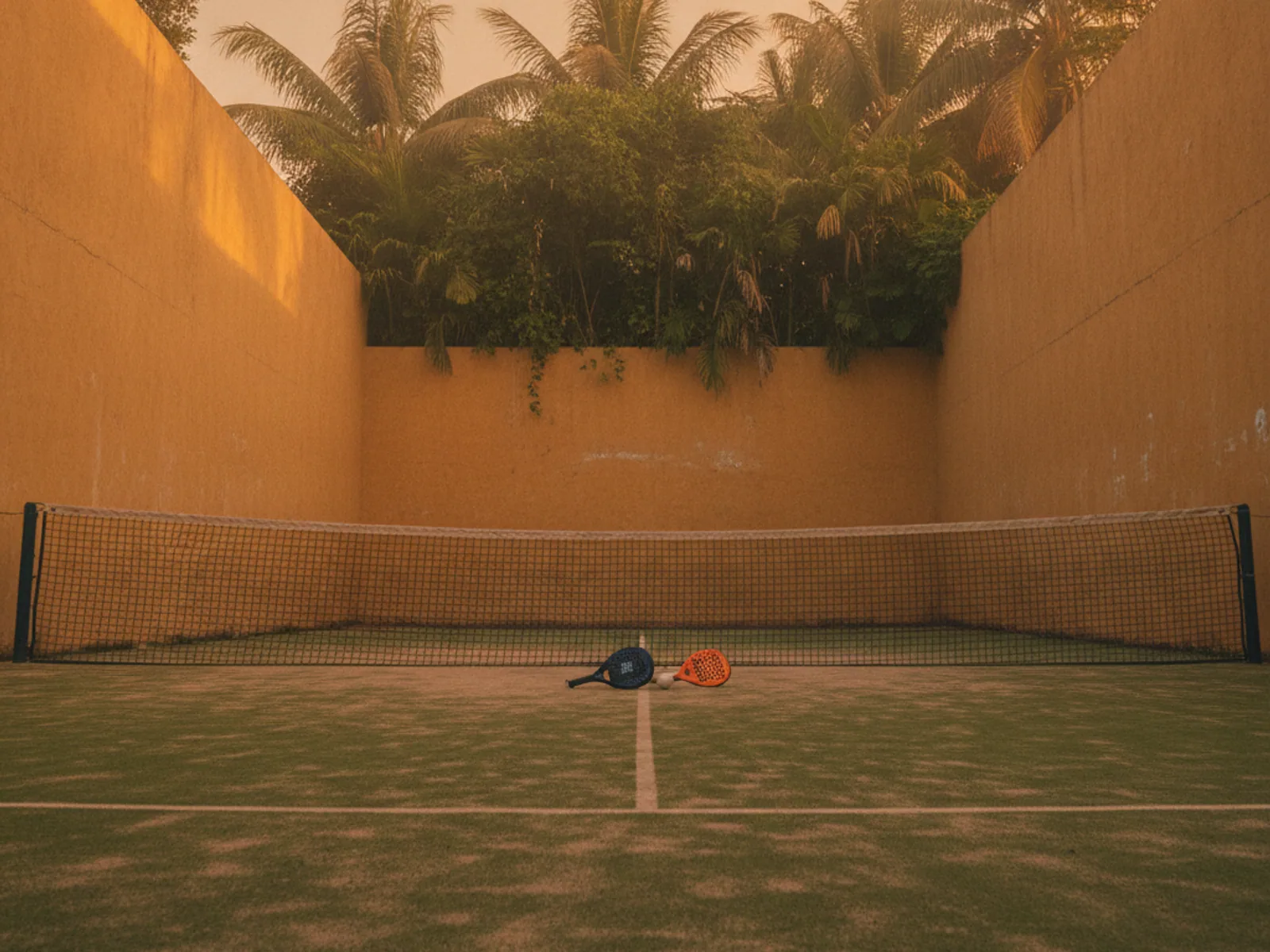
You’ve played a few times now. You’ve worked out that the walls are the whole point, that the ball you gave up on comes back off the glass, and that the people who look good are the ones who wait. Somewhere along the way, somebody told you padel is a Spanish sport.
It isn’t, or it wasn’t. Padel is Mexican by invention, Argentine by upbringing, Spanish by adoption, and American by accident. The court you booked last week was worked out in a backyard in Acapulco in 1969 by a man who didn’t have room for a tennis court, and the idea he started from came off a New York playground. If you’re brand new and want the sport before the story, what padel is covers the basics.
TL;DR
Padel was invented in 1969 by Enrique Corcuera at his home in Las Brisas, Acapulco. He had no room for a full-size tennis court, so he built a smaller one, 20 by 10 meters, and walled it in. His wife Viviana wrote the first rules and gave them to him as a birthday present.
- 1969, Acapulco. One man, one small plot of land, one net, and walls that were only ever meant to be a fence.
- The ancestor is American. Paddle tennis on New York playgrounds in the 1920s, then platform tennis in Scarsdale in 1928.
- Spain took it, Argentina raised it. Courts in Marbella in the early 1970s, then Argentina, where it became a real sport with the world’s first national association.
- It reached the US in 1993, in Houston, and then sat quietly for decades before anyone noticed.
Who invented padel
Enrique Corcuera had a house at Las Brisas, in Acapulco, and a piece of land next to it that was too small for a tennis court. Plenty of people have been in that position and built a pool. He shrank the court instead: 20 by 10 meters, a tennis net across the middle, and walls three meters high around the edge. That was the first padel court that ever existed, in 1969.
The rules came from his wife. Viviana Corcuera, a former Miss Argentina, wrote the first set down and gave them to him as a birthday gift, which is a nicer origin than most sports get. No committee, no governing body, no equipment manufacturer. A birthday present.
The court you play on today is essentially his. The footprint, the net down the middle, the walls in play. Fifty-odd years of pro tours and glass engineering have refined the building, not the idea.
Padel didn’t come out of a design process. It came out of a space problem, and almost everything strange about the sport traces back to that.
The American game that came first
Before Acapulco, there was a playground in New York. Paddle tennis was introduced on New York playgrounds in the early 1920s by Frank P. Beal, as a scaled-down tennis a kid could play in a space the city actually had. It spread fast enough that an American association for it existed by 1922.
Then somebody solved winter. In 1928, in Scarsdale, New York, two men adapted Beal’s game for it: a raised wooden deck, heaters underneath to melt the snow off it, solid paddles, a spongy ball, and a screen running all the way around the edge so the ball stayed in play.
That’s platform tennis, and if you’re reading this from the Northeast, the ancestor is still being played near you every winter. It never died. It just stayed home.
Corcuera had tried a version of the game on a trip to the States before he built his court. How the idea actually traveled isn’t documented tightly, and accounts differ on which of the two American games he saw. The direction is not in doubt, though: a walled-in, scaled-down racket game was being played on wooden decks in New York decades before anyone in Mexico picked up a racket for it.
So, is padel a European sport? No. It’s a Mexican sport with an American parent that Europe made famous. If you’ve been feeling late to it, you’re partly holding something your own country invented and put down.
Why padel has walls
The walls were not a design decision. They were a fence.
Corcuera put them up to stop the vegetation invading the court and to keep the balls out of his neighbor’s property. That’s the problem he was solving. The walls that define the entire sport, that make padel different from tennis and different from pickleball, exist because a man in Acapulco didn’t want to keep knocking on the door next door. The bouncing turned out to be more fun than the tennis he was trying to imitate, and the accident became the game.
Once you know that, the sport’s logic falls out of it. The ball stays alive, so hitting hard mostly buys your opponent another chance at you. Power gets recycled off the glass and handed back.
That’s why the patient pair beats the powerful pair most weeks at club level, and why a tennis convert starts out losing to people they’d beat on a tennis court in straight sets. If that’s you, padel for tennis players walks through what to keep and what to unlearn.
Patience isn’t an absolute, though. The wall rewards waiting when it gives you a ball at a comfortable height with room behind it. When you’re jammed against the glass with a low, fast rebound on you, waiting is just losing slowly, and the answer is to get the racket up early and buy time with a lob. And if squash is your reference point, don’t assume the walls behave the way yours do, because the rule is inverted: padel vs squash has the specifics.
The habit to build is small. Stop treating a ball heading for the back glass as a ball you’ve lost. It’s a ball on its way to you.
How padel got to Spain and Argentina
Prince Alfonso of Hohenlohe spent his summers at Corcuera’s place in Acapulco, played the game there, and in the early 1970s built courts at the Marbella Club Hotel in Andalusia. That’s how padel got to Spain: through a holiday.
Julio Menditeguy, an Argentine who belonged to Alfonso’s tennis club in Marbella, saw it and took it home. The first Argentine courts went in at Club Tortugas and the Mar del Plata Ocean Club. And this is where the story stops being about wealthy men’s holiday homes, because Argentina is where padel actually grew up.
The tell is which country got organized first. Not Spain, which had the courts and the glamour. Argentina founded the Asociación Padel Argentino in 1988, the first national padel association anywhere in the world, and hosted the first international match, Spain against Argentina, in Mar del Plata that January.
Spain got the sport first. Argentina got serious about it first, and the vocabulary, the coaching, and a lot of the pro game still carry that accent.
The glass court that let padel travel
The most underrated date in padel’s history is 1989, and it’s an engineering one. In Mar del Plata, a coach named Jorge Galeotti built the first detachable, transportable glass court.
Before that, a padel court was construction. You poured, you built, you had a court forever, and expanding the sport meant convincing somebody to permanently alter their property.
After that, a court was a delivery. It could be trucked in, bolted together, played on, taken apart, and moved somewhere else. That single change is the reason padel could go abroad at all, and it’s the direct ancestor of the courts in your local club.
It also explains where those clubs are. Roughly three padel courts fit inside the area of one tennis court, which is why a facility looking at its underused tennis or a landlord looking at an empty warehouse keeps reaching the same conclusion. It’s approximate, and the real fit depends on ceilings, columns and doors, but the ratio is the reason padel keeps appearing in industrial parks and parking structures rather than in purpose-built stadiums.
Doubles tennis puts four people on that footprint. Padel puts about a dozen on it, all paying.
So when your club is in a converted warehouse off a highway with a slightly odd ceiling height, that’s not the sport being cheap. That’s the sport doing the exact thing that let it leave Argentina.
Padel or paddle: how the name got settled
For a long time the sport couldn’t agree on its own spelling. Argentina wrote it “paddle.” Spain wrote it “padel.” Both meant the same game.
Institutions arrived first. The International Padel Federation was founded in Madrid on 12 July 1991 by the Argentine, Spanish and Uruguayan associations, and the first World Championships followed in 1992 in Madrid and Seville. Then in 1997, in Barcelona, Spain and Argentina sat down together, unified the rules, and standardized the name as “padel.” One D, no argument.
Eleven national federations existed at the end of the 1990s, five in Europe and six in the Americas. There are a hundred of them now.
The spelling is still a useful tell for a US reader, just not the one you’d expect. Over here, “paddle” almost never means this sport. It means pickleball, or it means platform tennis, or it means somebody has typed the wrong word into a booking system. If a club near you advertises “paddle,” check what’s actually on the courts before you show up with a padel racket.
When padel reached the United States
Padel was first introduced to the United States in 1993, by Ed Thompson and Felipe Arnold, at the Houstonian Hotel Club and Spa in Houston, Texas. The first padel court ever built in the country was in Texas, and it went in 24 years after Acapulco.
Sit with that gap. The idea left American playgrounds in the 1920s, went to Mexico, went to Spain, grew up in Argentina, built itself a federation and a world championship, and only then came back.
“The US was late to padel” is the line everybody uses, and it’s only half right. The US wasn’t late to the idea. The US was late to wanting it back.
And 1993 didn’t start a boom either. The Houston court sat there while padel got popular on other continents. What finally changed it was much more recent: an outdoor, non-contact, four-person sport turned out to be exactly the thing people wanted during the pandemic years, and clubs have been converting space ever since.
Where it stands now, we’d rather use our own count than somebody’s market estimate. Our directory tracks verified US clubs in two thirds of the states, and well over a thousand individual courts between them. That court number is a floor, not a total, because not every club publishes how many courts it has.
It’s also more than 30 years since Houston and the map is still filling in, which is the honest version of “growing fast.” The full breakdown lives in our US padel statistics.
How to see padel’s history on your own court
The history is only worth knowing if it changes something on Tuesday. Three things to do with it.
- Play one ball off the back wall on purpose this week. Not the ones you’re forced into. Pick a deep ball you’d normally sprint down early, let it pass you, turn with it, and wait for it to come off the glass at hip height. That’s the fence Corcuera built, working for you.
- Go find the modern version of his backyard. Our US padel court directory has the clubs we’ve verified, city by city, so you can book one near you rather than guess.
- Get one useful thing a week. Subscribe to the Sunday Drop for a weekly email from us: one fixable habit, plus a US court worth knowing.
Not bad for a man who just wanted his neighbor to stop finding tennis balls in the garden.
FAQ
Who invented padel?
Enrique Corcuera, at his home in Las Brisas, Acapulco, in 1969. He didn’t have room for a full-size tennis court, so he built a 20 by 10 meter version and enclosed it with three-meter walls. His wife, Viviana Corcuera, wrote the first set of rules and gave them to him as a birthday gift.
Is padel a Spanish sport?
Not originally, no. It was invented in Mexico, and Argentina is where it first became an organized sport with a national association and international matches. Spain adopted it early, in the 1970s, which is why most people assume it started there.
Why is it spelled padel and not paddle?
Because Spain and Argentina agreed on it. Argentina spelled the sport “paddle” for years while Spain used “padel,” and in 1997 the two countries met in Barcelona, unified the rules, and standardized the name with one D. In the US today, “paddle” usually points at pickleball or platform tennis instead.
When did padel come to the United States?
In 1993, when the first padel court in the country was built at the Houstonian Hotel Club and Spa in Houston, Texas. Arriving and catching on are two different things, though. It stayed a curiosity here for decades while the sport got big elsewhere, and the real US growth has only happened in the last few years.