
What is padel? The wall-bouncing racket sport arriving fast in the US
Padel is a doubles-only racket sport played on an enclosed glass court where the ball plays off the walls. What it is, where it came from, and how to start.
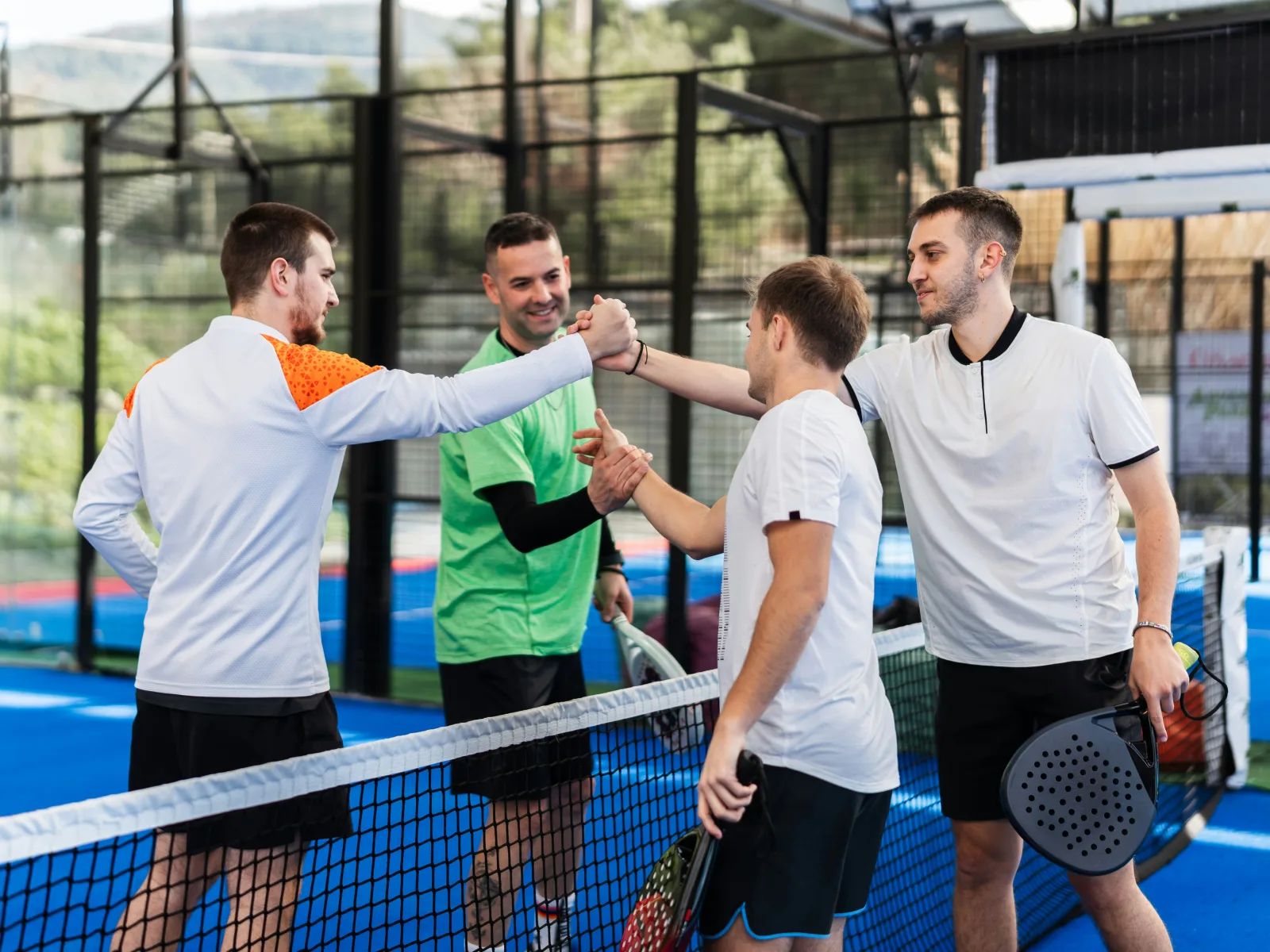
You keep hearing about padel. A friend won’t shut up about it, a court opened near you, or you saw a clip of a rally that ricocheted off a glass wall and didn’t make sense. Here’s the version that tells you what padel actually is, where it came from, and how to play your first session, without pretending it’s “mini tennis” or a fancier pickleball. It’s neither.
TL;DR
Padel is a doubles-only racket sport played on an enclosed court about a quarter the size of a tennis court, where the ball can be played off the glass walls; the serve is underhand and the scoring is the same as tennis.
The short version of why people get hooked:
- It’s social. Always doubles, four people, smaller court. You’re never far from the action or the conversation.
- It’s easy to start. You’ll rally in your first session. No big serve, no years of lessons before it’s fun.
- The walls change the game. A ball off the back glass is still in play, which makes for longer rallies and a skill ceiling that goes on forever.
What padel actually is
Padel is doubles, always. Four players, two a side, every match, every level. There’s no singles version you’ll meet at a club.
You play with a solid foam racket (no strings) and a ball that looks like a tennis ball with a little less air in it. You serve underhand, bouncing the ball and striking it at or below your waist, so the rally starts gently instead of with a cannon. From there, the scoring is the one thing you already know: 15, 30, 40, game, identical to tennis.
The part that makes padel padel: the court is enclosed, and the ball can come off the walls and still be in play. A shot that lands deep and rebounds off the back glass isn’t a winner against you. It’s your next shot, if you wait for it. That single rule reshapes everything about how points are played.
Knowing that much is enough to walk onto a court. The full rule set, the serve edge cases, what’s in and what’s out, lives in our guide on how to play padel, the complete rules and scoring. Read it before your first game.
What a padel court looks like
Picture a glass box. A padel court is 20 meters long and 10 meters wide, split across the middle by a net, and wrapped in walls: roughly 3 meters of glass at the back, with metal mesh above it, and a mix of glass and mesh down the sides. It’s about a quarter of the area of a tennis court.
The size and the enclosure are the whole point. Because the court is small, four people cover it comfortably, and you’re rarely sprinting flat-out to a ball you have no chance at. Because it’s enclosed, almost nothing is out of reach, and rallies run longer than you’d expect.
That changes the instinct of the sport. In most racket games, a ball past you is a lost point. In padel, you turn, let it rebound off the wall, and play it back. Learning to read the glass instead of fearing it is the moment padel clicks.
Where padel came from
Padel isn’t new, even if it’s new to your zip code. It was invented in 1969 by Enrique Corcuera at his home in Acapulco, Mexico. He built an enclosed court roughly 20 by 10 meters, put up walls, and strung a net across the middle. The shape we play on today is essentially the one he sketched out at his house.
From there it traveled. It reached Spain in 1974, when Alfonso de Hohenlohe built the first courts at the Marbella Club. A year later, in 1975, Julio Menditeguy carried it to Argentina, where it took off and became one of the country’s most popular sports.
That’s why padel can feel like it appeared overnight in the US and also like it’s been around forever. Both are true. It’s had strong player bases in Spain, Argentina, and Italy for decades, with the game also growing across the Middle East and the UK. The US is just the latest country to catch on, about half a century late.
Why padel is taking off
It’s social by design. Doubles only, on a small court, means four people sharing one tight space and usually a drink after. It’s easy to start: you’ll have real rallies in your first hour, because the underhand serve and slower ball lower the barrier that keeps people off a tennis court for years.
Then the wall game keeps you. You’ll rally on your first day and still be learning to play off the glass months later. Not many sports hand you a real game that fast and still have that much left to figure out.
As for the US boom: instead of quoting a stat we can’t stand behind, we’ll point to our own work. Padelkin’s US padel court directory maps the clubs and courts we’ve verified across the country, and we add to it constantly. New clubs are opening in cities that had none a year ago. That’s the growth, mapped court by court, not a number we made up.
Your first session, and the gear
You need almost nothing to start. Padel uses a solid foam racket (no strings, holes drilled through the face) and a low-pressure ball, and nearly every club keeps loaner rackets at the desk, so book an intro slot, ask to borrow a racket, and bring court shoes. Most clubs run a beginner session that gets you rallying the same day. The strokes come quickly; using the walls on purpose takes a few sessions more, and that’s the fun part.
How padel differs from tennis and pickleball
Two quick myths to kill, because everyone reaches for them.
Padel is not mini tennis. Yes, the scoring matches and the ball is similar. But the racket has no strings, the serve is underhand, the court is enclosed, and the walls are in play, so power gets recycled instead of rewarded. If you came from tennis, some of your best instincts will work against you at first. Our guide for padel for tennis players walks through exactly what to keep and what to unlearn.
Padel is not pickleball either. Both are social doubles games on a smaller court, and we respect the overlap. The big difference is the walls: padel has them, pickleball doesn’t, and that one fact splits the two sports into different games entirely. The padel court is also bigger. We break the whole thing down in padel vs pickleball.
How to start playing padel
You don’t need to understand everything to begin. You need a court, a partner, and one booked hour.
- Find a court near you. Browse our padel court directory to find a padel court near you, sorted by state, and book an intro or open-play slot. Ask the club up front what they provide for rackets and balls, and what it costs, so nothing surprises you when you show up.
- Read the rules first. Skim the full rules guide before you show up, then read it again after. The second read is when the rules turn into muscle memory.
- Learn where to stand early. Position wins more beginner points than power, so before you chase the fancy shots, focus on where you and your partner stand.
- Get one habit a week. Subscribe to the Sunday Drop for a weekly Padelkin email: one fixable habit at a time, plus a US court worth knowing.
Book the court, borrow a racket, and go. The rest you learn by playing.
FAQ
Is padel the same as tennis?
No. Padel borrows tennis scoring (15, 30, 40, game), but that’s about where the overlap ends. The racket has no strings, the serve is underhand, the court is a quarter the size and fully enclosed, and the ball plays off the walls. If you’ve played tennis, plenty of your instincts carry over and a few will fight you, mostly the ones built on power and on chasing every ball before it bounces.
Is padel like pickleball?
They’re cousins, not twins. Both are social doubles games on a smaller court, but padel is played inside glass walls that keep the ball alive, and the court is bigger. The walls change the strategy completely: a ball that would end a pickleball rally is often just the start of the interesting part in padel.
Where did padel come from?
It was invented in 1969 by Enrique Corcuera at his home in Acapulco, Mexico, on an enclosed court with walls and a net across the middle. It reached Spain in 1974 and Argentina in 1975, where it became one of the country’s most popular sports, and has since grown across Italy, the Middle East, the UK, and now the US.
Do I need my own racket to try padel?
No. Most clubs keep loaner rackets at the front desk, so for your first session you just need court shoes and a booked slot. Ask for a racket when you reserve, play a few times, and buy your own once you know you’re hooked.