
Padel vs Squash: What are the main differences between the two
The real differences between padel and squash: the inverted wall rule, court size, rackets, scoring, and serve, plus what carries over from squash.
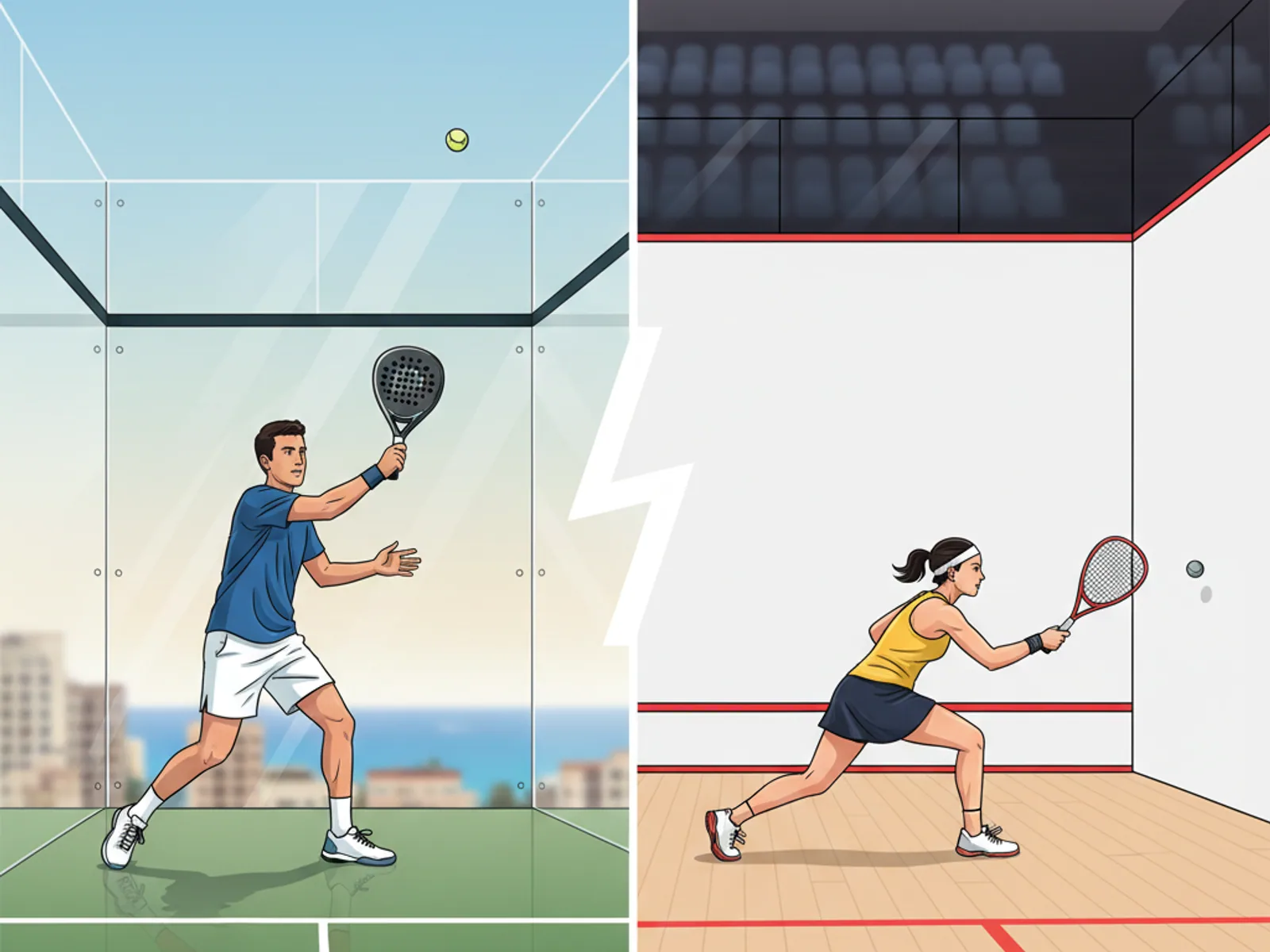
If you play squash, you already own most of what padel asks for: fast feet, a read on where the ball is going, and no fear of a wall. Then you step on court, swing the way squash taught you, and the ball does something rude. The reason is the one rule squash players assume transfers and it doesn’t: the wall does the opposite job here.
Both sports put a wall in play. That’s exactly the trap. The rule underneath is inverted, and that single inversion explains the swing, the patience, and the fact that you now have a partner.
The short answer
Squash and padel both put walls in play, but the rule is inverted. In squash, every shot must reach the front wall. In padel, the ball has to bounce in your opponent’s court first, and you may only play the glass on your own side. Padel is doubles, on a court about three times the size.
- The wall rule flips. Squash: hit the front wall, every time. Padel: land it in their court, and use only your own glass on the way.
- Doubles, not singles. Padel is played two against two. You share the court with a partner.
- The court is about three times bigger. More ground, more time, a different kind of running.
- Scoring is borrowed from tennis, not point-a-rally. Games go 15, 30, 40, then sets.
If you’re brand new to the sport and want the ground floor first, here’s what padel is in one read.
The wall rule is the whole difference
In squash, the wall is your target. Every shot you hit has to reach the front wall and rebound off it, and it has to clear the tin (480 mm of sheet metal along the bottom). Miss the wall, catch the tin, and the rally’s over. Your whole game is organized around getting the ball to that front wall, cleanly, under pressure.
In padel, the wall is not the target. It’s what happens after the ball bounces. Your shot has to bounce in your opponent’s court. Full stop. That’s the requirement. The glass only enters the picture in two ways, and they’re on opposite sides of the net.
On your side, the glass is legal before you send the ball back. A ball flies past you, hits your own back glass, and you play it off the rebound. That’s normal padel, and it’s the part squash prepared you for beautifully.
On their side, the glass is legal only after the ball has bounced in their court. You can’t fire the ball straight into their back wall on the fly and call it good. It has to land in the court first, then it can kiss the glass. Send it into their wall without a bounce and you’ve handed them the point.
So here’s the inversion in one line. Squash: the wall is your target, every shot must reach the front wall. Padel: the wall is aftermath, and you may only use the glass on your own side, before you send the ball back over. Same word, opposite job.
The court and the kit, in numbers
Physically, the two sports barely overlap. Here it is in numbers.
| Aspect | Padel | Squash (singles) |
|---|---|---|
| Court | 10 m wide × 20 m long, min. free height 6 m | 9.75 m × 6.4 m |
| Walls / tin | Glass and mesh all around; the ball must bounce before touching their wall | Front wall is the target; tin runs 480 mm up the bottom |
| Racket | Solid, no strings, holes 9–13 mm; max 45.5 cm long, 26 cm head, 38 mm thick; no max weight | Strung; max 686 mm long, 215 mm wide, 255 g |
| Ball | 6.35–6.77 cm across, 56.0–59.4 g, bounce 135–145 cm dropped from 2.54 m | Smaller, softer, low-bounce rubber |
| Serve | Underhand, bounce first, at or below the waist, diagonal | From the service box, must reach the front wall |
| Scoring | 15 / 30 / 40, deuce and advantage | Point-a-rally, games to 11 |
| Format | Doubles, best of 3 sets | Singles, best of 5 (or best of 3) |
The service line, if you’re looking for it, sits 6.95 m from the net on each side. The service box you knew in squash was a 1600 mm square. Different world.
The floor area is the number to picture. A padel court is about three times the size of a singles squash court (200 m² against 62.4 m²). Think of your squash court, then imagine three of them stitched together, and you’ve got roughly the space you’re now covering with a partner instead of alone. Longer recoveries, less scrambling. You have time you never had.
What your squash swing does to a padel ball
Squash rewards a fast, compact swing with wrist in it. You flick, you cut, you generate pace off a short backswing because the ball is soft and the court is tight. That swing is a liability in padel, and the glass is what punishes it.
Take a big backswing near the back wall in padel and one of two things happens: you clip the glass on the way back, or you’re still winding up when the ball arrives off the rebound and you’re late. The ball is livelier than a squash ball, the wall behind you is closer than instinct says, and the compact, controlled block does more than the full swing ever will. If there’s one stroke to rebuild from scratch, it’s the volley: the padel volley is short, firm, and punches the ball rather than swinging through it.
This clip lays the swing and preparation difference side by side, filmed by someone who plays both sports, so you can see exactly how much backswing you’re carrying over that you don’t need:
One more thing your squash racket never had: a wrist cord. Padel rackets carry a mandatory strap (up to 35 cm) that loops around your wrist, and using it isn’t optional. Drop the racket mid-point and you lose the point. It’s a small detail, but it’s the concrete tell that you’re holding a genuinely different object: solid, holed, stringless, tethered to your arm.
Scoring and serving feel backwards at first
Squash scoring is clean: win the rally, win the point, first to 11 (win by two at 10-all), and the match runs best of five or best of three. Padel borrows tennis. Games go 15, 30, 40, with deuce and advantage; the first pair to six games wins the set, but you need a two-game margin; tie down at 6-6 and you play a tie-break; the match is best of three sets. It’s more scaffolding than you’re used to, and the first few matches you’ll lose track of the count. That passes.
The serve is the bigger shock, and it’s a muscle-memory thing, not a rules-memory thing. In squash you serve however you like as long as it finds the front wall. In padel the serve is underhand and constrained: you bounce the ball on the ground first, you strike it at or below waist level, you keep at least one foot on the ground, and it has to travel diagonally into the opposite box. For a player whose serve has always been a weapon you flick from wherever feels right, being told to bounce it and hit it low will feel like doing it with the wrong hand. Give it time.
Why squash players start ahead
Here’s the good news, and it’s real. A squash background buys you a head start in padel, the same way a tennis background does. If you came from tennis, you already know the padel for tennis players crossover: footwork, reading trajectory, general court sense all transfer, and you’re ahead of someone who’s never held a racket.
Squash gives you all of that, plus two things tennis players show up without. First, you read a live wall already. A ball coming off glass isn’t a novelty to you; you’ve spent years playing rebounds, tracking angles off a surface, judging pace after a wall eats some of it. Tennis players have to learn that from zero. Second, you’re comfortable in a small enclosed box with a ball moving fast. That composure is worth a lot in the early weeks.
The catch is that the same instincts fire too early. In padel, a lot of balls are meant to go to the glass and come back to you at a friendly height. Your squash reflex is to take the ball early, kill it before the wall gets involved, because in squash the wall is the enemy’s next chance. In padel, letting the ball do its thing off your own glass is often the better play. The hardest habit to unlearn isn’t a stroke. It’s the urge to intercept a ball the wall was about to hand you for free.
Squash is an Olympic sport now, padel isn’t
Squash makes its Olympic debut at the Summer Games in Los Angeles in 2028. That’s a milestone the sport fought hard for, and squash players have every right to be loud about it. Padel isn’t on that programme. Will it ever get there? The sport is growing fast and clearly wants a seat at the table, but wanting one and being voted in are different things, and nothing is confirmed beyond squash’s turn. For now, the Olympic stage belongs to the other wall game.
Where to try padel if you already play squash
The fastest way to feel all of this is to book a court and let the wall reteach you in real time. There’s a good chance there are padel courts near you already, so check the directory and book one. If you’re still weighing which racket sport to pour your time into, the padel vs pickleball split is worth a look too, though for a squash player padel is the more natural jump.
A first session tends to go like this. The wall reads feel instantly familiar and you’ll surprise yourself with a few. The swing will betray you, big backswings clipping the glass, balls arriving before you’re set. The serve will feel silly at first. And you’ll take at least one ball early that you should have let bounce, out of pure squash reflex. All of that is the normal arc. Bring a partner if you can, because padel is doubles and half the game is learning to move as a pair.
If you want a short nudge each week as you make the switch, the Sunday Drop is one email, one idea, no filler. Otherwise: find a court, book an hour, and go unlearn your backswing.
FAQ
Is padel easier than squash?
Padel is generally faster to enjoy, because the underhand serve, the bigger court, and the walls that keep the ball alive mean rallies last longer and beginners get more balls back. Squash is more physically brutal per rally and punishes a weak shot instantly. “Easier” depends on what you mean: padel is easier to start and have fun, but reaching a high level in either is hard in its own way.
Can a squash court be converted into a padel court?
Not really. A padel court is about three times the floor area of a singles squash court, and it needs the full glass-and-mesh enclosure with open sides, not four solid walls. The footprint alone rules out a straight swap. A padel court usually goes into a much larger space, indoors or out, rather than into an old squash box.
Do squash players have an advantage when they start padel?
Yes, and more than tennis players in some ways. You already read a live wall and you’re comfortable in a fast, enclosed space, which are two of the harder things for a total newcomer. The advantage has a limit: your instinct to take the ball early and kill it works against you, because in padel the wall is often about to hand you a better ball.
Can you play padel as singles?
The standard game, and the version the rules are built around, is doubles: two against two. Singles padel exists and gets played on narrower courts, and we’ve seen custom-built small courts designed specifically for one-against-one, but none of that is official padel. If someone says “padel” without qualifying it, they mean the doubles game. Coming from singles squash, the shared court and the partner dynamic is one of the bigger adjustments.