
Padel vs Pickleball: The Complete Guide
Padel and pickleball, side by side. Rules, court, gear, learning curve, costs, and which one fits which player. For anyone deciding what to play.
If you keep getting asked “padel or pickleball?” and don’t have a clean answer, this is the version we wish someone had handed us. Both are real sports. Both are growing. They share less than the headlines suggest. Here’s the honest comparison, in the order that actually matters when you’re deciding which to commit to.
TL;DR: the 30-second verdict
- Pickleball is easier to start, smaller court, no walls, dominates suburbs and senior leagues. Most players are at a casual level by hour two.
- Padel has a higher ceiling, slightly bigger court (still small), walls in play, lives in urban clubs and the international touring scene. Most players need a few sessions to start using the walls on purpose.
- They are not enemies. Plenty of people play both. If you’re choosing, choose by access first (what’s near you?) and by what kind of game you actually enjoy second.
The court
This is the single biggest difference, and it shapes everything else.
Pickleball
- Court size
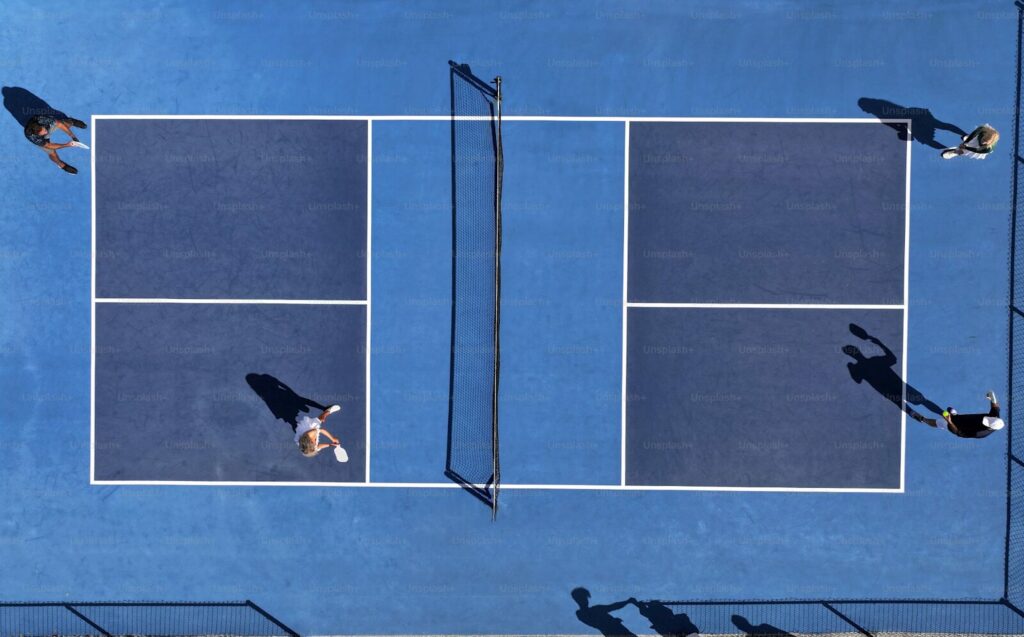
- 20 ft × 44 ft (6.1 × 13.4 m)
- Walls
- None
- Net height
- 34 inches at center
- Singles allowed?
- Yes
- Surface
- Hard court (acrylic or asphalt)
Padel
- Court size
- 33 ft × 66 ft (10 × 20 m)
- Walls
- Glass on the ends, metal mesh on the sides
- Net height
- 36 inches at center
- Singles allowed?
- No, doubles only
- Surface
- Artificial turf with sand infill
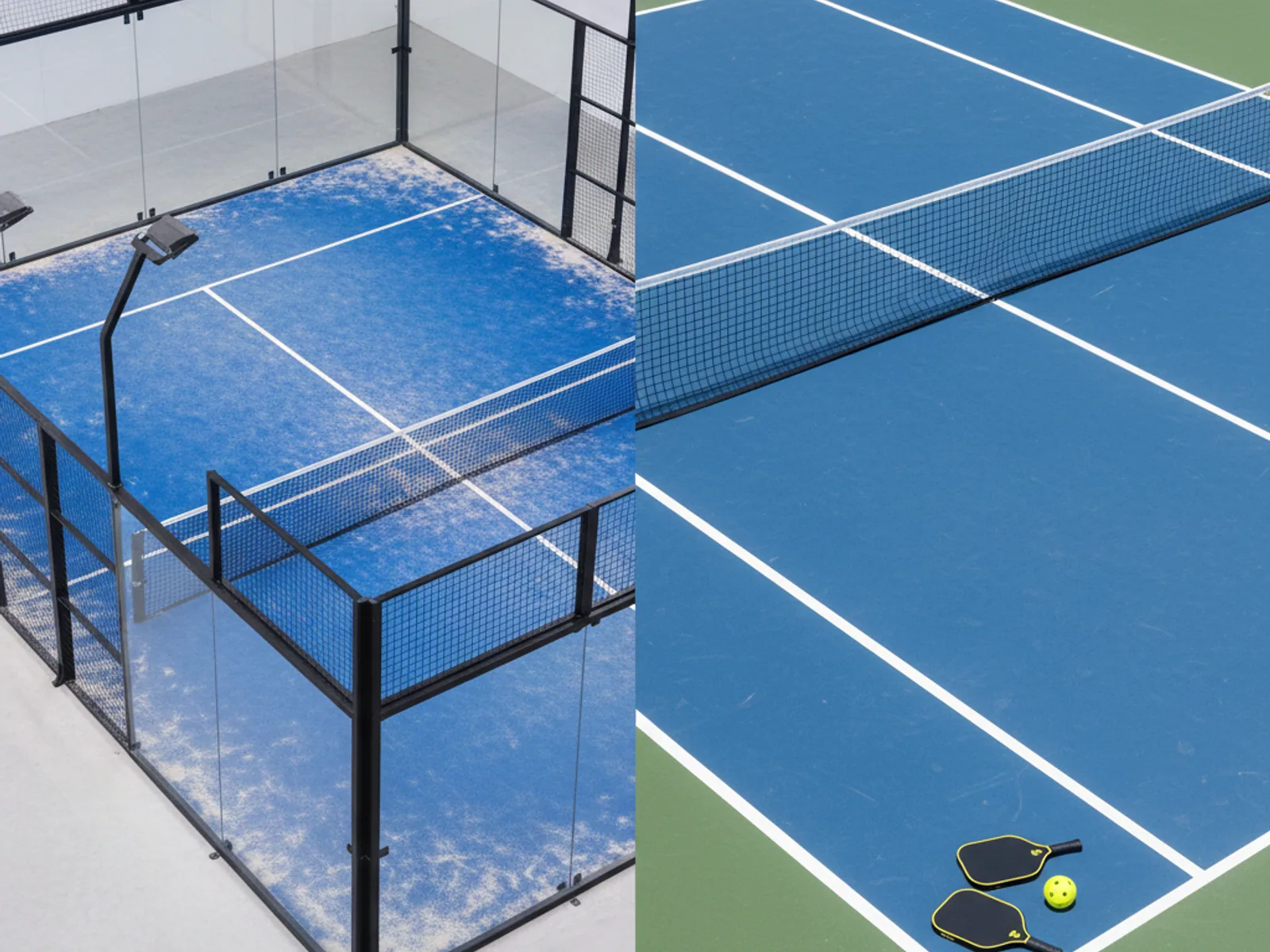
A padel court is about 2.5x the area of a pickleball court. Still small. Still doubles. The walls are in play on your own side, which means a ball that bounces off your back wall after a deep shot is not over. It’s a rally. This is the part that takes the longest to internalize if you’re coming from any other racket sport.
Pickleball is played outdoors as often as indoors, mostly on hard surfaces converted from tennis or built fresh. Padel is overwhelmingly played at private clubs because the court is a purpose-built structure: steel frame, glass, mesh, turf, and lighting, none of it cheap.
The ball
- Pickleball: A perforated plastic ball, like a Wiffle ball with smaller holes. Two flavors, indoor and outdoor, with different hole patterns and weights. Light, dies fast in wind, has a distinct pock sound.
- Padel: A low-pressure tennis ball. Looks identical to a tennis ball but with less internal pressure, so it bounces lower and slower. It goes dead faster than a tennis ball, so you swap in fresh ones more often.
The implication: padel rallies are longer and more dynamic because the ball still has tennis-like behavior off paddles and walls. Pickleball rallies are quicker, with more touch shots near the kitchen line.
The racket
- Pickleball paddle: Solid, flat, thin (around half an inch). Polymer or composite face. Weight 7–9 oz. Brands worth knowing: Joola, Selkirk, Paddletek, CRBN.
- Padel racket: Thicker (around 1.5 inches / 38 mm), with a foam core (EVA or polyethylene) and a carbon fiber or fiberglass face. Holes drilled through. Teardrop, diamond, or round-shape head. Weight 340–380 grams (12–13 oz). Brands worth knowing: Bullpadel, Adidas, Nox, Head, Babolat, Wilson.
The shapes matter. Pickleball paddles look like ping-pong paddles scaled up. Padel rackets look more like solid bricks with a handle, and the swing mechanics reflect that. Padel rewards forearm and wrist work; pickleball rewards quick hands and clean contact.
The rules
The fast comparison:
Pickleball
- Format
- Singles or doubles
- Serve
- Underhand, below waist, drop or paddle
- Scoring
- Rally to 11 (win by 2)
- Match length
- First to 11, sometimes best of 3
- Volleys
- Restricted in the "kitchen" (non-volley zone)
- Walls in play
- N/A
- Service let
- None
- Faults
- Standard
Padel
- Format
- Doubles only
- Serve
- Underhand, must bounce first, below waist
- Scoring
- 15-30-40, deuce, advantage. Same as tennis.
- Match length
- Best of 3 sets to 6 games
- Volleys
- No restriction
- Walls in play
- Yes, after one bounce on the floor
- Service let
- Replayed
- Faults
- Standard plus serving foot faults near the line
Two rules to call out specifically:
The kitchen is pickleball’s defining quirk. A 7-foot zone in front of the net where you can’t volley. It forces drop shots, dinks, and patience near the net. Strategically excellent. Confusing the first time you play.
Walls are padel’s defining quirk. Any ball that bounces on the floor first and then off your own back or side wall is still in play, and you have to handle it. Returning a wall-ball cleanly is a real skill. Many beginners forget the wall is there until the ball is already past them.
The learning curve
A rough timeline for a recreational athlete with some racket-sport background:
- Pickleball: Functional in your first session. Comfortable within a handful of sessions. Tournament-ready takes real practice, but the on-ramp is fast. The skill ceiling is real, just lower than padel’s.
- Padel: Rallying in your first session. Using the walls on purpose after a few more. Comfortable doubles play takes longer than pickleball, and a strong intermediate game takes a real commitment of court time. The skill ceiling is genuinely deeper.
If you’ve played tennis, padel will feel familiar but easier on the ball striking. If you’ve played squash, padel will feel familiar with the walls. If you’ve played badminton, pickleball will feel like a slightly weightier version of what you already know.
What it costs
Court fees:
- Pickleball: free at most public parks, with modest hourly rates indoors at private clubs.
- Padel: more than pickleball, and almost always at private clubs, since you’re paying for a purpose-built court. Some city clubs sell memberships that pay off if you play more than once a week.
Equipment to start:
- Pickleball: a starter paddle, a tube of balls, and court shoes if you don’t already have them. The cheapest way into any racket sport.
- Padel: a starter racket, padel balls, and court shoes (padel-specific ones have herringbone soles for the turf). More than a pickleball kit, but not by a wild margin.
Lessons: Group clinics are the affordable way to learn either sport, with private lessons costing more. Padel lessons tend to skew higher because there are fewer certified pros.
Where to find courts
This is where the two sports diverge sharply right now.
Pickleball is everywhere. There are tens of thousands of pickleball courts across the country, with new ones being lined onto tennis courts every week. If you live in a suburb with a public park, you very likely have a pickleball court within a short drive.
Padel is concentrated. Courts cluster in New York, Miami, Los Angeles, Boston, Houston, Austin, Chicago, and the Bay Area, and outside those metros a single club often serves an entire city. Smaller markets are getting their first courts every quarter. We verify clubs one by one and map over a thousand courts between them, so the directory is the place to find your closest one.
→ Browse padel courts by state
The vibe
This is squishier and more honest:
Pickleball culture has a suburban park energy. It skews older in mature markets (the senior leagues are real and they’re amazing), and younger in newer markets where tournaments and league play are exploding. There’s a strong DIY tradition. People bring their own paddles, gather chairs, and play four-rotation games for hours. Friendly. Loud. Communal.
Padel culture is urban and internationally inflected. Most clubs feel a bit like tennis clubs (locker rooms, pro shops, food and drink) because the court structure is expensive enough that no one builds them in driveways. The international touring scene (Premier Padel, World Padel Tour) is on TV, and the names (Tapia, Galán, Lebrón, Coello) come up a lot. Friendly, but the room feels different.
You’ll know which vibe is yours within one session.
Where each sport is heading
Pickleball is in late-saturation mode. The pro tours are professionalizing (the PPA Tour, MLP), broadcast deals are happening, paddle technology is iterating fast. The growth curve is flattening because almost every metro that wants pickleball already has it. Expect deeper professionalization, less new-court growth, more tournament infrastructure over the next three years.
Padel is early. The Asian Games 2026 marks padel’s first appearance as an Olympic-pathway medal sport. New courts open weekly, and the count is climbing fast. Pro events draw bigger sponsors every season. We expect the sport to look meaningfully more mainstream in two years than it does today.
If you’re choosing what to invest your time in, both are real sports with real futures. Padel is just at the earlier point of the curve.
The Padelkin take
We’re padel-first because we think padel is in a rare moment, the kind where a sport finds its identity in a new market and the people who care early get to shape the room. Pickleball had that moment in the early 2020s. Padel is having it now.
That said: pickleball is great. We don’t dunk on it. The people who say “padel will replace pickleball” are wrong. They coexist. Tons of players play both. Pickleball has the access advantage. Padel has the depth advantage. Choose what fits, or play both.
So which should you actually play?
A quick decision tree:
- You live in a suburb with a free pickleball court 5 minutes away: Start with pickleball. The access advantage is real, and you can add padel later if a court opens nearby.
- You played tennis and miss the depth: Padel. You’ll click with it faster than you expect, and it scratches the same itch as tennis without the same physical demands.
- You came from squash: Padel. The walls.
- You want a casual social game with friends: Pickleball. The on-ramp is faster, the kitchen forces patience, and a four-person game is easy to organize.
- You want a sport that gets more interesting as you get better: Padel. The skill ceiling is deeper, the wall game compounds, and the international scene gives you a long horizon to grow into.
- You want both: Both. Plenty of players keep a pickleball paddle in the trunk and book padel courts on weekends.
Ready to try padel?
If padel is winning you over, the next move is simple: pick a court from the directory above and book an off-peak hour to keep it cheap. Brand new to the sport? What is padel covers the basics, and how to play padel walks the full rules before your first match.
Then subscribe to the Sunday Drop for a weekly read on the gear, the courts, and the US scene. Already set on pickleball? Have fun, and send this guide to a friend who hasn’t decided yet.