
Padel footwork: the two meters that decide the point
Padel footwork isn't about getting faster. Almost all of it happens inside two meters. The split step, the brake, and the one time you turn and run.
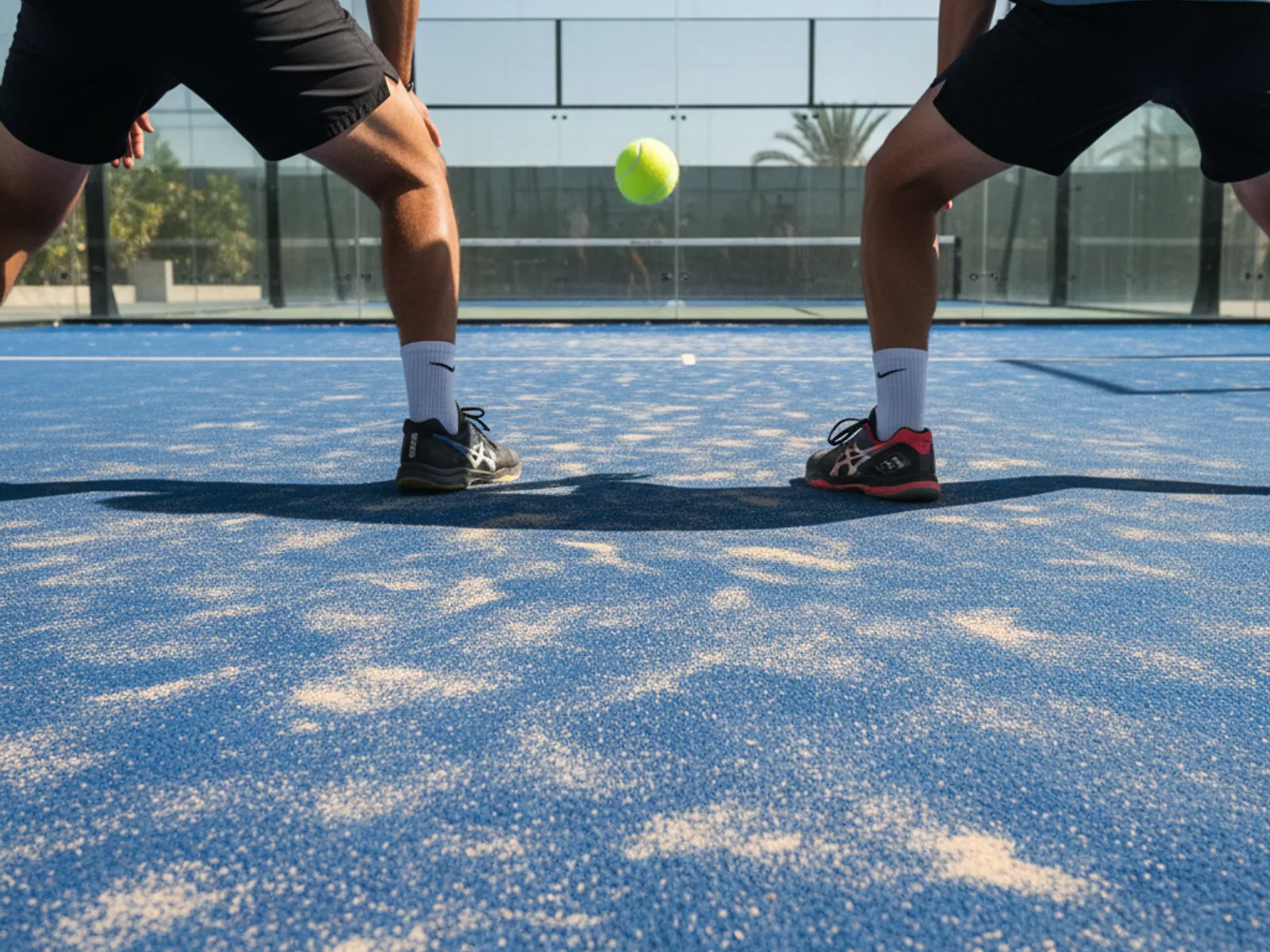
You got there. Ball in front of you, racket back, and it still came off the frame or floated up for a free smash. The arm takes the blame. The feet earned it.
Padel movement isn’t what most footwork advice assumes. It’s short, it repeats, and the hard half is stopping. Four movements make up almost all of it, and the rule every other page leads with is wrong about the biggest one.
TL;DR
Padel footwork is mostly short: about four in five of the accelerations and the braking a professional does happen inside two meters, so the split step that starts you and the brake that stops you balanced matter more than top speed.
- You’re not slow, you’re late. A hop timed to their contact is what fixes that.
- Stopping is the skill. Any ball you hurried for is hit after the brake, not during it.
- “Never cross your feet” is half a rule. True sideways, wrong going back to the glass.
- Take the step after the shot. Recovery costs attention, not fitness, and nobody does it.
What padel footwork actually is
Footwork usually means speed: quicker feet, a ladder before you play. Then somebody measured it. In professional matches, roughly four in five of the accelerations, and four in five of the hard stops, happen inside one to two meters. About the length of your bed.
A pro still covers a bit over two miles in a match, none of it straight, on a court 20 m end to end. You move constantly, in a box you can’t run in.
Top speed never comes up. Starting on time comes up on every ball. Padel court positioning decides where you need to be; footwork decides whether you get there in time to use it.
Ladders aren’t useless. They’re aimed at the wrong target: the two meters in front of you.
The split step: how you start on time
A small hop that lands as your opponent strikes the ball. Feet wider than your hips, weight forward, knees soft. You land loaded, so the first step is a push instead of a decision, and you’re moving sooner than you would from flat feet.
The tell is where your eyes are while your feet are quiet. Watching the ball come off their racket with both heels down means you’re late. The first step becomes a lunge, the lunge a reach, and the reach is the shot you’ll blame on your technique.
Do it on every ball but the slow, high one you read early. That one you can walk to.
Stopping is the harder half
Roughly four in five of the decelerations live inside that same one to two meters. You brake about as often as you accelerate.
The wall keeps feeding pace back at you, so control beats power, and control comes from a base that has stopped moving. A walking adjustment you can hit right through; anything you hurried for, you hit after the brake, not during it.
Arriving isn’t the job. Arriving still is.
One extra small step beats one big lunge. Chop the last stride into two short ones, plant the outside foot, then swing. A lunge costs you the next ball too.
Braking is also the half that bills you later: knees and calves absorb every stop, and lower-body trouble is the bigger pile among common padel injuries. It’s only as good as the sole under it, too: the court is sand on turf, so you want padel shoes that give a little and then bite.
Three small steps and be still. Not two big ones and a stretch.
Going back for the wall: the one time you turn and run
Every footwork page leads with the same rule: never cross your feet. For the short sideways adjustment, which is most of what you do, it’s right.
For the trip back to the glass it’s wrong, and that trip is the biggest movement in the sport. The service line sits 6.95 m from the net, and behind it is about three meters of court, the only stretch long enough to travel rather than adjust. Shuffling it is slow. Backpedaling it is how people end up sitting down.
Five steps, in this order:
- Turn your hips the moment you read the lob.
- Run. Cross your feet and face the wall.
- Overrun it. Get past where the ball will land, not level with it.
- Turn and face the court as the ball comes off the glass.
- Step forward into contact. Weight toward the net, never leaning back.
Step three is the one nobody does. Arrive level with the bounce and the rebound lands on top of you; a step more and the same ball becomes a bajada, the attack off the back wall.
The exception is the short lob you handle with one step back, square to the net.
Sideways for a step. Turn and run for a wall.
The step after the shot
You hit a good one, and you watch it. Everybody does. We do it too, most weeks, at our own courts. Meanwhile the rally moved on and you’re standing where the last point was.
Recovery costs attention, not fitness, which makes it the cheapest point on the court. Move back toward the middle of your side while the ball travels. That middle isn’t painted on the floor, though. It’s relative to your partner, so if they’ve been dragged to the side wall, yours slides with them.
Hit, then move.
Padel footwork drills you can do with one partner
No ladder, no cones, no coach. All four need one partner.
- The split-step timing drill. They feed, you play, and the only thing judged is your hop. Have them call “late” when your heels are down at their contact.
- The stop-and-hold drill. Hold your finishing position for a beat after every shot. Wobble, and you arrived traveling.
- The wall-retreat drill. They lob deep, you turn, run, overrun, face up, step forward. Movement only at first, then add the ball.
- The recovery-touch drill. After every shot, a foot has to touch the middle of your side before their next ball. Miss it and the point doesn’t count.
How to improve your padel footwork
Feet get fixed with reps, not reading.
- Pick the split step and nothing else for one session. Land the hop as they hit, and let everything else stay broken for now.
- Book a court and run the four drills. Find a court near you in the padel court directory and give the start of the slot to your feet.
- Get one habit a week. Subscribe to the Sunday Drop for one fixable thing at a time, plus a US court worth knowing.
Nobody ever bought better feet.
FAQ
What is the most important footwork in padel?
The split step, because it decides whether everything else starts on time. A hop landing as your opponent hits leaves you loaded to push off instead of flat and reacting. Brake, shot and recovery all get easier when the start is early enough.
Should you cross your feet in padel?
Half the time. For the short sideways adjustments that make up most of your movement, keep your feet apart and shuffle. For the long retreat to the back glass, turn your hips and run: shuffling that far is slow, and backpedaling it is how people fall.
How do I move to the back glass in padel?
Turn your hips as soon as you read the lob, run facing the wall, and get past where the ball will land rather than level with it. Then turn to face the court and step forward into contact. That extra step of room is what lets you attack the rebound instead of survive it.
Do agility ladder drills help your padel footwork?
A little, and less than they promise. Ladders train foot speed in a pattern you already know, while padel asks you to start and stop inside two meters, in a direction you didn’t know a second earlier. Court time on a real ball buys more.