
Indoor vs outdoor padel: what the building does to your game
Your club is indoor or outdoor and you never really picked. What wind, sun and a roof change, what they don't, and the gap your home court leaves.
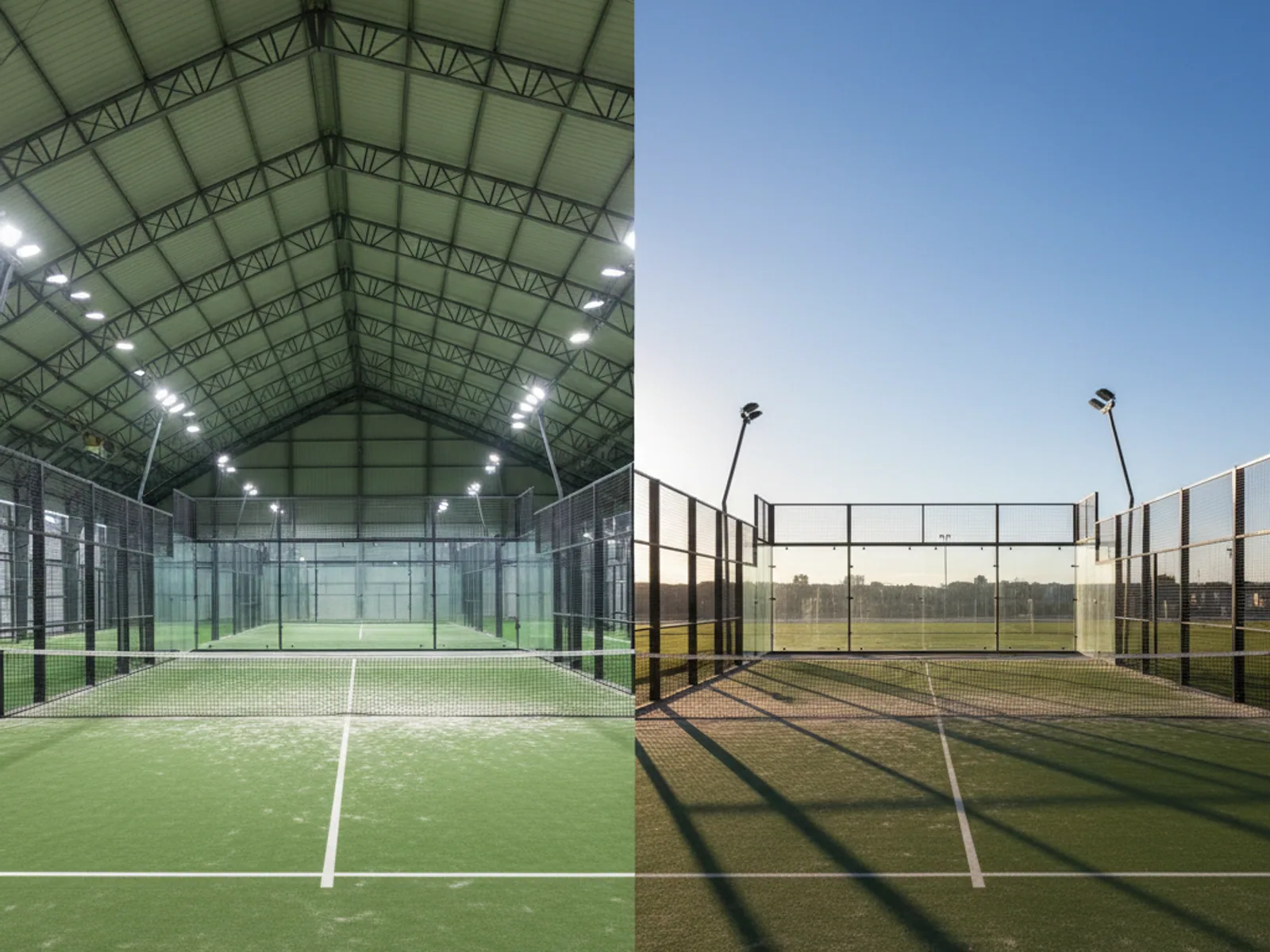
You didn’t choose your court. You chose a club with a free slot at seven, or the one 20 minutes away instead of 50, and whatever was over your head came with it. Then you learned the game on it, and the other kind stayed theoretical.
The rules don’t change between the two. The conditions do, and they’ve been coaching you this whole time: building one skill you’d never have picked up on the other surface, and quietly skipping a chapter you’ll need the first time you travel.
TL;DR
Same sport, same rulebook. What’s over your head changes the conditions, and the conditions have been building your habits for you.
- Nothing in the rules splits them. Same court, same scoring, same ball, same walls.
- Outdoor teaches margin. Wind, sun and heat make you read the day before you read the ball.
- Indoor teaches pace. Nothing interferes, so the game speeds up and precision pays. The roof is the one thing to check.
- You probably don’t get a choice. Fewer than one in ten clubs in our directory have both kinds.
- The fix is one session. Book the kind you never play, before a match books it for you.
What actually changes, and what doesn’t
No, these aren’t two formats. There is no indoor rulebook. Court dimensions, net height, scoring, the ball spec, what you’re allowed to do off the walls: one set of rules, and it doesn’t care whether there’s a sky above you. The court in a converted warehouse is the same court as the one baking in the sun.
| What the building changes | What it can’t touch |
|---|---|
| Wind, and it’s a different wind at each end | Court size, net, walls, mesh |
| Sun, glare, and where the shadow line falls | Scoring and the rules of play |
| Temperature, and what it does to the ball | The ball spec: one legal ball for both |
| Whether there’s a ceiling in play | How the back wall hands you the ball |
| Light: floodlit, daylight, or dusk | Every technique a coach would teach you |
A table is a tidy version of a messy thing. Indoor clubs vary from each other about as much as weather varies from itself: a purpose-built hall and a warehouse with a low roof are not the same room, and a covered court with open sides is really outdoor padel with shade. So stop hunting for the rulebook difference. The difference is in what each building lets you get away with.
Where US padel actually is, indoors and out
We run the courts directory, so we can check instead of guessing. Of the 264 club pages we publish, 238 tell us what kind of courts they have. The other 26 we haven’t typed yet, so read the rest of this as the shape of US padel rather than a census.
Nationally it’s close to a coin flip. Indoor and outdoor clubs land within a couple of clubs of each other, near enough half and half. That national average is also wrong about almost every city in the country, which is the useful part.
Cold states run about two indoor clubs for every one outdoor. California runs roughly seven outdoor for every one indoor, and New York runs the other way, better than three indoor for every one outdoor. Illinois, Utah and Connecticut don’t have a single outdoor club between them.
Florida is the one that looks like a mistake. The state that never needs a roof for winter is dead even, indoor and outdoor, which makes sense the second you’ve tried to play there in August. A roof in Florida isn’t fighting winter. It’s fighting a heat index and a four o’clock thunderstorm.
Your zip code picked your court, not your preference. And switching usually means driving, not booking a different court at your own club: fewer than one in ten of the clubs we’ve typed offer both. Worth knowing what your own metro actually has, so find padel courts near you and see which type you’ve been quietly specializing in.
What outdoor padel does to your game
Wind is the first thing you notice outdoors, and it’s easy to read wrong.
Wind isn’t one condition, it’s two, and you swap between them at every changeover. With it behind you, the lob keeps going and your smash finds the fence. Into it, the same lob stalls in the air and drops short, which is a free bandeja (the controlled overhead that holds the net) for the pair in front of you. Same swing, same intent, opposite result, and the only thing that changed was which end you were standing on.
The mistake is hitting that lob identically from both ends and then blaming your touch. Downwind, take height off it and land it shorter than feels right. Into the wind, you can hit it bigger than you’d ever dare under a roof, because the air is going to take some of it back. Crosswind is the sneaky one: it doesn’t kill the lob, it slides it toward the side wall and hands them an angle.
Wind gets the blame. What outdoor players actually complain to us about is the sun at one end, and there’s a reason for it in the rulebook: the recommended orientation for an outdoor court is north-south, with a little variation toward north-northeast or north-northwest allowed. Built that way, the low morning and evening sun sits off your side wall instead of hanging behind an end.
It’s a recommendation, not a requirement, and plenty of US courts got built to fit the lot that was available. If one end is fine and the other has you smashing blind at six o’clock, your court isn’t running north-south. The good news is that the end that blinds you blinds them too. When you’re at the friendly end, lob more.
Heat gets into the ball, and the rules concede it in the one place they have to: above 1000 m of altitude, a different, lower-bouncing ball is allowed. Denver and Salt Lake City both sit above that line, so it’s a real US problem rather than a footnote about the Andes. At sea level you get the softer version of the same effect, and a can doesn’t play the same in July afternoon heat as it does on a cool evening. If you want the actual numbers, how padel balls behave carries the spec.
Outdoors you learn to read the conditions before you read your opponents.
The cost shows up on the still evenings. Safety stops being a choice and becomes the setting: you take the extra ball, add margin nobody asked for, and when a genuinely clean ball finally turns up, you shepherd it back instead of hitting through it. Read the day in the warm-up, then play the end you’re on.
What indoor padel does to your game
Indoors, nothing interferes. The ball goes where you sent it, the light at nine in the morning matches the light at nine at night, and one end isn’t damp. Without wind to hit around, you flatten the ball out and aim closer to the lines than you would outside. Indoor padel is more honest that way: a loose ball is loose, and it comes back at you at exactly the pace you gave it.
The one real variable is over your head. The rules define the court as the insides of the walls, the fence, the ground, the net and the posts. A ceiling isn’t on that list, so it isn’t part of the court at all, which is why the point it decides doesn’t go the way you’d guess, and why plenty of US clubs with low roofs post a house rule of their own. Learn yours before a league point turns on it: what happens when a padel lob hits the ceiling covers both the rule and the local caveat.
A low roof costs you more than the occasional let. It edits a shot out of your game without telling you. The tell: you stopped lobbing and you never decided to.
Watch one set of your own defense. If your answer to being pinned at the back is a drive every single time, the building made that call, not you. A settled net pair eats a drive it can see coming. The wall behind you was offering the time to lob instead.
The upside is pace, and the nerve to attack a ball rather than nurse it. Every shot gets an honest answer, so you find out quickly what your technique actually does.
What it leaves is your first outdoor match. Wind isn’t a skill you pick up during a warm-up, and the player who has never played in it gets found out, usually while insisting the balls are wrong.
If your club has a roof, your technique is probably ahead of your judgment. That’s the good version of the problem. It’s still a problem.
Your first five minutes on an unfamiliar court
Run this every time you play somewhere new, and once at your own club this week, because you’ve probably never actually checked.
- Ask the desk about the roof. Two words does it: “ceiling rule?” Finding out mid-tiebreak is the expensive way.
- Find the wind before you need it. Hit two lobs from each end in the warm-up. Two, not one, so you can tell the wind apart from a bad first lob.
- Look straight up from both ends. Outdoors, toss a ball and track it with your eyes at each end. One end will usually be worse. That’s the end where you want a flatter lob and where they’ll be trying to make you look up.
- Feed the back wall twice. One deep ball, one short. Two courts that look identical can hand the ball back at different speeds, and 30 seconds tells you whether you’re taking it early or waiting on it.
- Check what’s under your feet. Sand level, damp patches, a surface that’s been in the sun all afternoon. Slide once on purpose, before you have to slide for real.
Five minutes, indoors or out. Cheapest thing you’ll do for your game all week, and you can do it tomorrow.
How to switch between indoor and outdoor padel courts
You can’t change what your club has. You can go meet the other kind on purpose, once, instead of meeting it in a tournament draw.
- Run the five-minute check at your own club this week. Start with the one you’d never think to check: the ceiling rule, or the sun end.
- Book one session on the kind you never play. Not a league night, not a match that matters. A session where the whole job is noticing. Where to play padel in the US is the quickest way to find one inside driving distance.
- If you only play indoors, get outside before your first tournament, not at it. Wind is a surprise you can schedule.
- Subscribe to the Sunday Drop for one fixable habit a week, plus a US court worth knowing.
Your building has been coaching you since the day you joined. Go find out what it left out.
FAQ
Is outdoor padel harder than indoor padel?
Half. Outdoor is harder to control: wind moves your lob, the sun takes your smash, and the ball doesn’t play the same at four in the afternoon as it does at eight in the evening. It’s also more forgiving, because indoors a loose ball comes straight back at you, while outdoors the conditions might eat it. On a still evening, they’re the same sport.
Does wind really change how you should play padel?
Yes, mostly through the lob and the overheads: downwind your lob carries and needs less height. Into the wind it stops short, which is where free smashes come from. Crosswind slides it toward the side wall and gives them an angle. The adjustment isn’t hitting harder, it’s changing height and target depending on which end you’re standing at.
What happens if the ball hits the ceiling on an indoor padel court?
Under the FIP rules, a ceiling isn’t part of the court. If your shot bounces in your opponents’ court first and then hits the ceiling or the lights, it’s a correct return and the point is yours. You lose it only when the ball hits the ceiling before bouncing. Plenty of US clubs with low roofs run their own house rule, so check what’s posted at yours.
Do I need different equipment for indoor and outdoor padel?
No. Same racket, same shoes, same ball, and anyone telling you otherwise is selling something. The one genuine exception is altitude: above 1000 m the rules allow a lower-bouncing ball, which matters if you play somewhere like Denver or Salt Lake City. Outdoors, the only real additions are a hat and sunglasses you can comfortably look up in.