
What is the chiquita? The soft shot that beats driving
Driving every ball off the back glass? Meet the chiquita, padel's soft shot to the net players' feet, and the smart way to take the net.
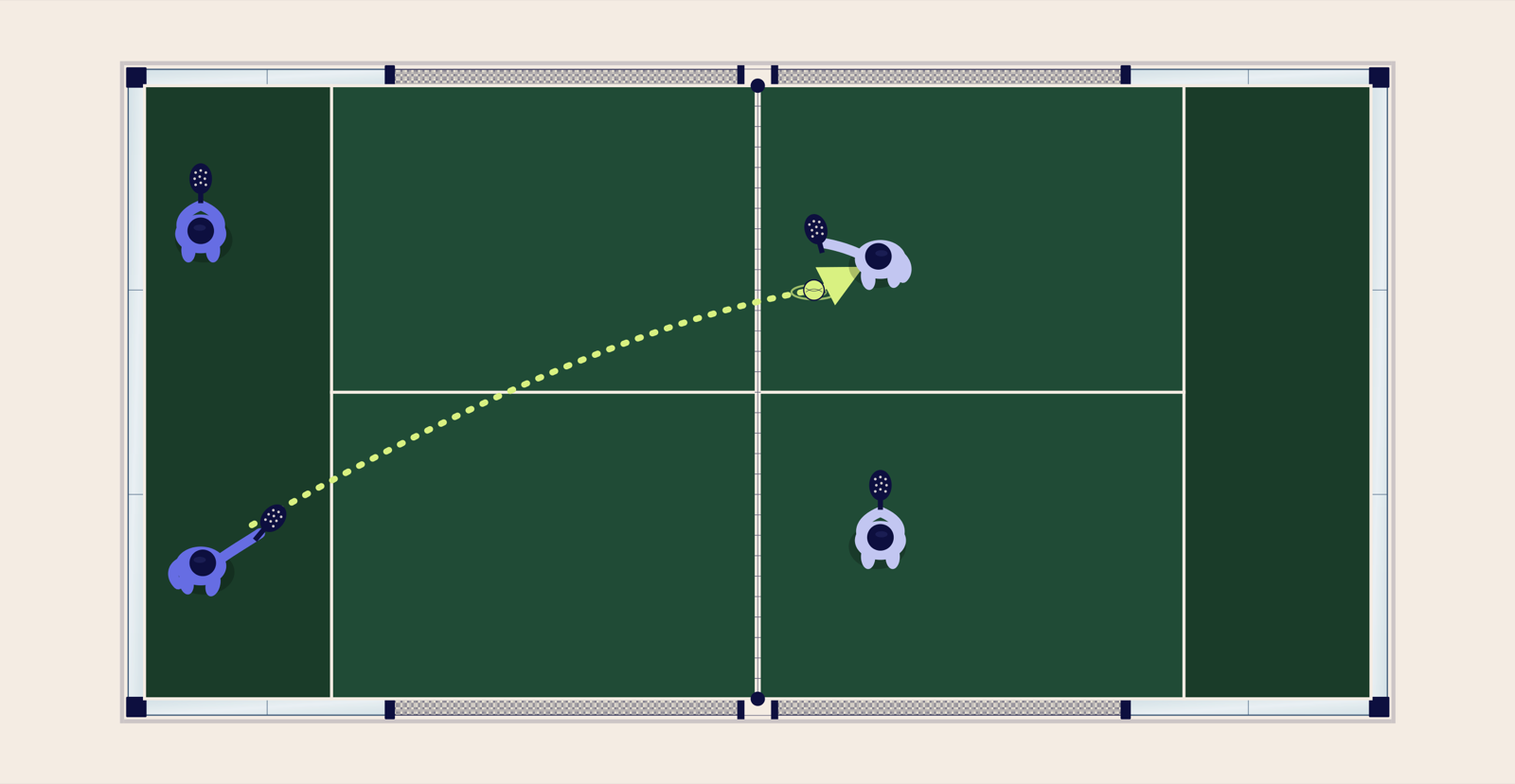
When the ball comes off the back glass, your hand wants to do one thing: load up and drive it past them. Almost every player who came up hitting groundstrokes has the same reflex. And in padel, against a team that’s already at the net, that reflex is the thing keeping you stuck.
There’s a softer shot that does more damage than your drive ever will. The Spanish call it the chiquita, the little one. It looks like you’ve given up on the point. It’s actually the smartest way to take the net away from the team that owns it.
TL;DR
The chiquita is a soft, low ball you float to the feet of the net players when you’re stuck at the back. It beats the drive because the net team can crush a hard ball, but a ball at their shoelaces has to be lifted, and a lifted ball is yours to attack.
- Soft over hard. A drive feeds a team that’s looking to volley. A ball at their feet doesn’t.
- Aim at the gap, not the lines. The space between them, or the space they’ve left, beats a low-percentage pass down the wall.
- Hit it flat. Chasing spin on a soft touch shot just costs you control. Slow the swing down instead.
- Follow only a good one. A low chiquita earns you a step forward. A floater that sits up means stay back and defend.
- Mix it with the lob. One drags the net team down, the other pushes them back. Disguised from the same prep, they’re brutal together.
What the chiquita is, and why it beats the drive
A chiquita is a soft, low ball played from the back of the court, aimed to drop at the feet of the team at the net. Chiquita means “the little one” in Spanish, and the shot goes back to the Argentine roots of the modern game. The name is the whole idea: small, quiet, easy to underrate.
Here’s the logic that makes it work. When two opponents are at the net and you drive the ball, you’re handing pace to a team that’s set up to volley. They redirect your power and you’re worse off than before. But a ball that lands at their feet can’t be hit down. To get it over the net, they have to open the racket and lift, and a lifted volley floats up soft. That’s your cue. You and your partner step in and the next ball is the one you attack.
So the chiquita isn’t really a defensive shot. It’s a way to turn the team’s own net position against them. The closer they’re hugging the net, the more their feet are exposed, and the better the shot gets.
From the back, you’ve really got three options, and they’re not interchangeable. Each asks the opponents to do something different:
| Shot | What it does | When to use it |
|---|---|---|
| Drive | Tries to pass or beat the net team with pace | They’re out of position, or you’ve got a genuinely clean ball |
| Lob | Pushes the net team back, off the net | They’re crowding the net and you need to move them off it |
| Chiquita | Drags the net team down to their feet | They’ve drifted back with space in front of them, and you have time to step in |
Read the table top to bottom and the pattern is clear. The drive gambles. The lob and the chiquita build. Most of the time, building wins.
When to play it
The chiquita is a situational shot, not a default. Play it from the back, against a team at the net, off a ball you’re comfortable with. The ball should be in front of you so you can step into it. If you’re reaching, stretched, or playing it with your back near the glass, it’s the wrong moment. Lob instead and reset.
The other half of the read is the space in front of the net team. Coaches put a rough number on it: you want something like two to three meters of room between the opponents and the net for the shot to land in. If they’re glued to the net, there’s nowhere for the ball to drop and you’re better off lobbing them back. The window opens when they’ve drifted back a little, sitting around the second post or just in front of it. That’s the gap the chiquita is built for.
A useful image for the pace: hit it soft enough that the ball almost reaches the first post and dies. Not to the service line, not to the back wall. Short and low, into the space at their feet.
And know before you swing whether you can follow it. From a deep position, getting to the net takes you a beat too long, somewhere around a second and a half to two seconds, which means a chiquita you hit from the back is a setup, not an invitation to charge. More on following it below. The point for now: where you’re standing decides whether this shot moves you forward or just keeps you alive.
How to hit it
The mechanics are simpler than the decision: the swing is just touch, and the hard part is choosing the shot.
Soft and low: placement over power
This is a feel shot. Soft hands, a short controlled swing, and almost no pace. The thing you’re managing is racket-head speed, not effort. Slow the racket down and the ball stays soft and low.
A note on spin, because it trips people up: hit the chiquita flat. Brushing heavy topspin onto a soft ball mostly costs you control without buying you much. Flat and slow is the version that travels low and lands where you’re looking. Some advanced and pro players add a little shape to it, but that’s a variation to chase much later, not the way to learn the shot. Learn it flat.
Where to aim: the feet and the gap
Aim at their feet, or at the gap between the two of them. Not the lines. A chiquita down the wall is a low-percentage pass dressed up as a soft shot, and it’s not what the shot is for. You want the ball to land where they have to reach down and lift, which is at their shoelaces and in the space they’ve left open.
One thing to weigh: which side you aim at changes who covers the middle afterward. If you go cross-court, the middle of the court opens differently than if you go straight, and that affects where your partner needs to be. So cross-court isn’t automatically the “safe” choice, it’s a choice about coverage. Pick the gap that’s actually there, then make sure your partner reads the same picture.
Then move: follow it to the net (only a good one)
A chiquita is an invitation to take the net, but only when it’s a good one. If the ball lands low and forces the lift, step in behind it and bring your partner with you. The volley’s coming up soft and you want to be there to put it away.
If the chiquita floats, sits up, or lands too deep, do the opposite. Stay back. A bad chiquita that you charge behind is a free pass for the net team, who’ll punch the volley into the space you just vacated. Read your own shot in the air. Good one, go. Bad one, hold and defend.
Beginner vs intermediate: what the chiquita does at each level
The same shot does different work depending on who’s across the net, and it’s worth knowing which job yours is doing.
At the club level, a clean chiquita often just wins the point. Opponents misjudge the low ball, freeze, or pop up a volley so soft it’s basically a gift. That’s real, and it’s a great reason to start using the shot early. Don’t lean on it as a winner, though, because the habit that lasts is the one underneath.
At higher levels, the chiquita almost never wins on its own. Good players read it and get the lift back over. What it does instead is set up the next ball: it drags them down, floats their volley, and hands you the put-away one shot later. That second-order payoff is the real point of the shot.
So even as a beginner, treat every chiquita as a setup, not a finish. If it wins outright, great, take it. But you’re training the habit of playing one shot ahead, and that habit is what carries you up the levels. This is the same construct-don’t-finish logic that runs through all the smart shot selection in padel.
Chiquita or lob? Use both
People treat these as either-or. They’re a pair. The lob pushes the net team back, off the net and toward the glass. The chiquita drags them forward, down to their feet. One stretches the court long, the other pulls it short, and a team that has to defend both directions is a team in trouble.
The trick that makes them deadly is disguise. Prepare for both the same way, so the opponents can’t read which is coming until the ball’s gone. If your body screams “lob” every time you lob and “drop” every time you chiquita, good players will cheat early and eat both. Same shoulder turn, same setup, two completely different balls. Now they have to wait, and waiting is exactly what you want.
There’s a situational cousin worth knowing once the basics land. After a lob has pushed the opponents deep and opened a big gap in front, a slightly firmer chiquita can double as an approach shot, carrying you into the net behind it. Soft is still the default, every other time. This is just the version for the moment the court has cracked wide open.
The mistakes that kill a chiquita
Most failed chiquitas aren’t bad technique. They’re bad decisions, and they come down to a few repeat offenders.
- Too hard. A chiquita with pace on it is just a slow drive, and a slow drive at a net team is a volley waiting to happen. The whole shot lives or dies on being soft.
- Too high. A ball that clears their feet sits up at a comfortable volley height, and now you’ve fed the team you were trying to disarm. Low is the entire job.
- Wrong contact point. Take the ball in front of your hip, with soft hands and a short swing. A ball you let drift behind your body line forces a worse, tenser shot, and the chiquita is the last shot that survives being rushed.
- Charging the bad one. Following a floaty chiquita into the net hands the opponents the open court. Only a good one earns the step forward.
- Treating it as a winner. Above club level it isn’t one. Hit it to set up the next ball, not to end the rally on the spot.
One more thing worth knowing: the most common answer to a chiquita is another chiquita. If they drop it back at your feet, don’t panic and don’t drive it. Match the patience, or change the picture with a lob.
How to practice the chiquita
You build a chiquita with reps and a clear target, not with a coach barking at your swing. Here’s the order that works.
- Feed and drop. Have a partner feed you balls from the net while you stand at the back. Forget winning. Land soft, low balls at their feet, aiming for that “almost reaches the first post” pace. Hit a dozen in a row before you change anything.
- Add the read. Now have them stand sometimes tight to the net and sometimes a couple of meters back. Lob the tight ones, chiquita the ones with space in front. You’re training the decision, which is the part that actually breaks down in a match.
- Follow the good one. Once your contact is clean, add the step. When the chiquita lands low, move in behind it and take the next ball out of the air. When it floats, stay back. Make the go/no-go call out loud until it’s automatic.
Then take it live, with one rule for your next few matches: when you’re stuck at the back against a net team and you’ve got time, your default isn’t the drive, it’s the chiquita or the lob. You’ll feel under-aggressive for a session. Then it clicks, and for the first time you’ve got a real answer from the back.
A few concrete next steps:
- Book a court and drill it. Grab a partner who’ll feed you and find a court to drill it near you.
- Pair it with the shots that hold the net. The chiquita brings opponents down; learn how to hold the net once you take it with the bandeja, and how to win it back when you’re pushed off with the bajada.
- Get the next breakdown. Subscribe to the Sunday Drop and the next shot-of-the-week lands in your inbox before your next session.
Drive when the ball genuinely asks for it. The rest of the time, hit the little one. That’s the choice that moves you up a level.
FAQ
What does “chiquita” mean in padel?
Chiquita is Spanish for “the little one.” It’s a soft, low shot played from the back of the court to the feet of the team at the net, and it traces back to the Argentine roots of the modern game. The name fits: it’s small and quiet, and it does far more than it looks like it should.
Is the chiquita a topspin shot?
No, and learning it that way will hold you back. Hit it flat. Chasing spin on a soft touch shot mostly costs you control; the variable you actually manage is racket-head speed, slow the swing down to keep the ball soft and low. A little shape is an advanced variation, not the foundation.
When should I chiquita instead of lob?
Read the space in front of the net team. If they’ve drifted back and left room in front of them, the chiquita drops into that gap at their feet. If they’re crowding the net with no room in front, lob them back instead. Better still, disguise the two from the same preparation so they can’t tell which is coming.
Should I follow my chiquita to the net?
Only when it’s a good one. A low chiquita that forces the opponents to lift earns you a step forward, so move in and bring your partner. If it floats or sits up, stay back and defend, because charging behind a bad one hands them the open court.
Why does the chiquita beat just driving the ball?
A team at the net is set up to volley, so a hard drive gives them pace to redirect. A ball at their feet can’t be hit down; they have to lift it, and a lifted ball floats up soft for you to attack. You’re turning their net position against them instead of feeding it.