
The padel volley: soft beats hard at the net
Blasting volleys and watching them come off the glass? The padel volley: the setup volley, every variation worth knowing, and how pairs hold the net.
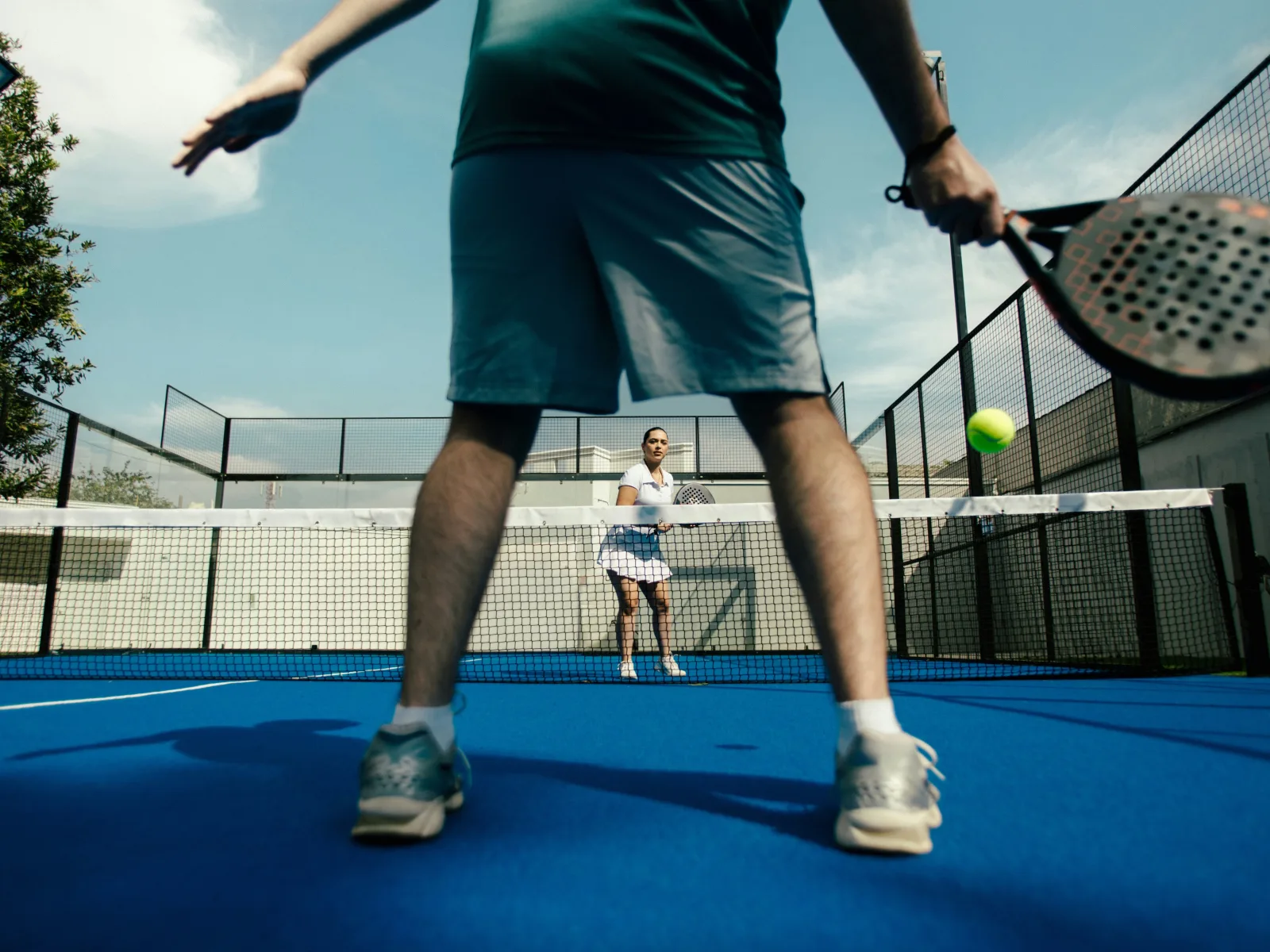
You get to the net, the ball sits up at chest height, and you do what every racket sport you’ve played taught you to do. You hit it hard. It clips the back glass, comes off clean, and the pair you just attacked is putting the next ball at your feet.
You know that rally. The fix isn’t a better volley. It’s understanding what the volley is for: at the net in padel you’re usually not trying to end the point, you’re trying to build the ball that ends it.
TL;DR
- Position beats swing. Winning pairs barely out-volley losing pairs. They badly out-position them.
- Soft beats hard. A sliced volley that dies low near the back glass buys you the next ball. A hard one gets recycled by the wall.
- The volley that wins the point is usually the one before it. That’s the setup volley, and it’s the whole idea here.
- Fix your ready position first. It’s the single biggest change most beginners can make at the net.
Why the net is worth this much
You arrive at the net behind a deep lob, or behind a chiquita, the soft ball at their feet that forces them to hit up. What you do once you’re standing there is the rest of this page.
And it’s worth standing there. Studies of professional matches put about 80% of winners near the net, and find that winning pairs spend more time in the net zone and play more of their attacking shots from it.
One study compared winning and losing pairs across pro matches: volleys made up 26.8% of the winners’ strokes against 25.0% for the losers. That’s close to nothing. The winning pairs played 41.2% of their shots from offensive areas, against 35.3% for the losers.
So the volley gap was tiny and the position gap was not. Getting to the net and staying there mattered more than what you hit once you arrived. Where you stand decides which volleys you ever get to hit, which is the real subject of padel court positioning.
The volley that wins the point is the one before it
You’re at the net, a comfortable ball comes over, and you deliberately don’t attack it. You play it softer instead, with slice, so that when it bounces the second time it’s low and close to the back glass.
That’s the setup volley. It forces your opponents back to the glass and opens the space for you to attack the next ball.
Think about what you just did to them. They’re pinned against the wall, digging a low ball out of the corner with no angle to hurt you. Whatever comes back is slow, high, or short. That is the ball you attack. You didn’t win the point with a winner. You won it with the volley two shots earlier.
The discipline is picking the right ball. If the volley you’re facing is low over the net and awkward, don’t force it. Play two or three more normal volleys and wait for a better one. The same logic governs the bandeja, the controlled overhead that holds the net: its job is to maintain pressure while keeping your net position, not to end the rally.
One line worth taping to your bag: aim at your opponent’s feet or the angles, because precision beats power up there. Soft has a second advantage too. Pace you don’t add is pace they can’t borrow.
The volleys actually worth knowing
English volley naming isn’t standardized. Coaches split these categories differently and you’ll hear one shot called three names. The Spanish is the stable anchor.
- Block volley (volea de bloqueo). Racket as a shield, firm wrist, almost no swing. Your answer to a ball drilled at your body, or to a smash coming back at you.
- Low volley (volea baja). Knee height or below. Open the face, bend deep, lift it. You’re not attacking here, you’re keeping your net position.
- High volley (volea alta). Head height or above. Has a blocking version and an attacking version; the incoming pace decides which.
- Slice volley (volea cortada). Open face, cut under the ball, backspin keeps the bounce low. Most padel volleys carry slice, so treat this as the default shape rather than a trick.
- Drop volley (volea dejada). Very short follow-through finishing near the chest, face parallel to the ground so the ball gets no depth. Best when the other pair is deep after a lob.
- Attacking volley (volea de ataque). The one you swing through, deeper target, more pace. It earns its place when the ball comes slow and high and they’re stuck at the back. Play it on every ball and you’re back to getting the next one fired at your feet.
- Half volley (media volea). Struck immediately after the bounce, usually at your feet in transition. Defensive by nature, and more common in padel than in tennis. (You’ll hear media volea used loosely for any mid-height volley. After the bounce is the correct definition.)
Direction matters more than which of those you picked. Cruzada (cross-court) gives the biggest margin. Paralela (down the line) is tighter and asks your partner to cover behind it. A la verja (into the side fence) is the most effective and the riskiest. Al fondo (deep) is the safe reset, and plana (flat) is the safest and most predictable. Aim at feet and angles, not at gaps; the gaps have walls behind them.
Three terms you’ll meet online that aren’t padel terms: side volley, body volley, reflex volley. None of them show up in the glossaries. “At the body” is a target, not a shot.
”Tap out” is not a volley
You’ll hear this one at the net, though the formal glossaries don’t carry it. And it isn’t a volley. It’s an overhead.
The tap out is a soft, controlled tap instead of a full smash, usually played on a lob that’s dropped off the back glass into the corner. You aim it so the ball bounces in the opponents’ court and then clears the fence: placement, not power. That’s the point won, unless they get out through the court door and play it back from outside.
It’s a cousin of the x4 smash (por cuatro), the one that sends the ball out over the back. For the side-fence version, por tres, the kick smash has the full technique.
Two genuine volleys get garbled into it. Tapar is a block of an incoming smash or bandeja, which is the block volley above. Toque is a drop shot disguised as a normal volley, one that can leave the court through the door. Neither one is a tap out.
The technique that holds up
Fix your ready position first. Racket in front of you, vertical, at chest height, above the net line. Hold it right where you’ll be making contact with the ball. Most beginners let the racket sink between shots and then have to lift it to hit, and that lift is where the late, scrambled volley comes from.
The rest, roughly in order of payoff:
- Grip. Continental, the hammer or chopper grip, both wings, no changing. The edge points at the floor and the face opens on its own.
- Backswing. Very short, racket stays in front of the body. This is not a swing, it’s more of a firm block.
- Shoulders. A poor shoulder turn is the most common volley mistake there is. Skip the turn and your wrist ends up somewhere that makes a controlled volley much harder.
- Contact. In front, around the leading hip, face slightly higher than the wrist. Shoulder-led. No wrist snap, no follow-through past contact. Push, don’t hit.
- Legs. Step in with the opposite foot. On low balls, go low and bend rather than dropping the racket head; your arm is stronger down there because you can stretch it more.
- Dipping balls. When you’re in position but the ball is falling toward your feet, step forward and take it above net level instead of digging it out from below.
- Split step. Small quick jump, landing exactly as your opponent strikes. Too early and you’re on your heels, too late and the ball is past you. Run, split, hit. Don’t hit while still moving.
The backhand volley is where club players quietly bleed points. Take it earlier than you’d take a forehand, meeting the ball with the open face before it closes, wrist firm and slightly cocked back. A collapsed wrist rotates the face and nets the ball. Step across with your foot instead of reaching with your arm.
If watching lands better than reading, here’s a clean run through the volley itself, the ready position, and the footwork behind it. Worth ten minutes before your next session.
How pairs lose the net
Almost none of these are stroke problems.
- Splitting up. The rule is simple: if your partner goes back, you go back; if your partner goes to the net, you go to the net. Staying split leaves a huge gap on the diagonal through the middle.
- Standing too close to the net. No reaction time, and it invites the lob you can’t recover.
- Hitting too hard. Experienced opponents let your pace run to the glass and hand it straight back.
- Smashing while moving backwards. Let a deep lob come off the back glass and play it going forward instead.
- Not covering your partner’s paralela. They volley down the line, you don’t shift across, and the middle opens up.
- Silence. “Mine.” “Yours.” “Switch.” Free points, no technique required.
Spacing is where the advice genuinely splits: published recommendations run from 1–1.5 m off the net to 2–3 m depending on who you read. The cue we’d actually use is roughly halfway between the service line and the net, unless you’re actively attacking. And when you move sideways, move with the ball, not with your partner. Ball goes to their side, you shift toward the middle and let them cover wide.
How to practice the padel volley
- One session, one cue. Racket up at chest height, above the net line, reset there after every ball. Nothing else. Highest return of anything on this page.
- Feed yourself setup volleys. Have a partner feed from the back and play a run of volleys you’re not allowed to attack: soft, sliced, dying low near their back glass. Then take the ball that comes back.
- Book the court. None of this improves on a screen. Find one near you in the padel court directory and put an hour on the calendar.
- Subscribe to the Sunday Drop for one fixable habit a week, plus a US court worth knowing.
Next time you’re up there, ask one question before you swing: is this the ball, or is this the ball before the ball?
FAQ
Can you volley at any time in padel?
Yes, with one exception. The serve has to bounce before the receiver strikes it, so you cannot volley a return of serve. Every other ball in the rally is fair game to take out of the air, and at the net the answer is usually to take it, because hitting early is how you take time away from the other pair.
What is the difference between a volley and a bandeja?
A volley is struck in front of you before the bounce. A bandeja is played overhead: think half a high volley, half a controlled smash. The difference that matters is the job. The bandeja exists to maintain pressure and keep your net position, not to finish the point.
Should you volley hard in padel?
Usually not. Hard volleys come off the back glass and get handed straight back to you, and pace you add is pace your opponents can redirect. Swing through when the ball arrives slow and high and they’re stuck deep. The rest of the time, volley soft and sliced, at their feet or into the angles.
Where should you stand at the net in padel?
Roughly halfway between the service line and the net, unless you’re actively attacking. Standing right on the net looks aggressive and costs you reaction time, and it invites a lob you can’t chase down. The exact distance runs anywhere from 1–1.5 m to 2–3 m depending on who you ask, so treat the halfway cue as the working default and adjust to your own speed.